
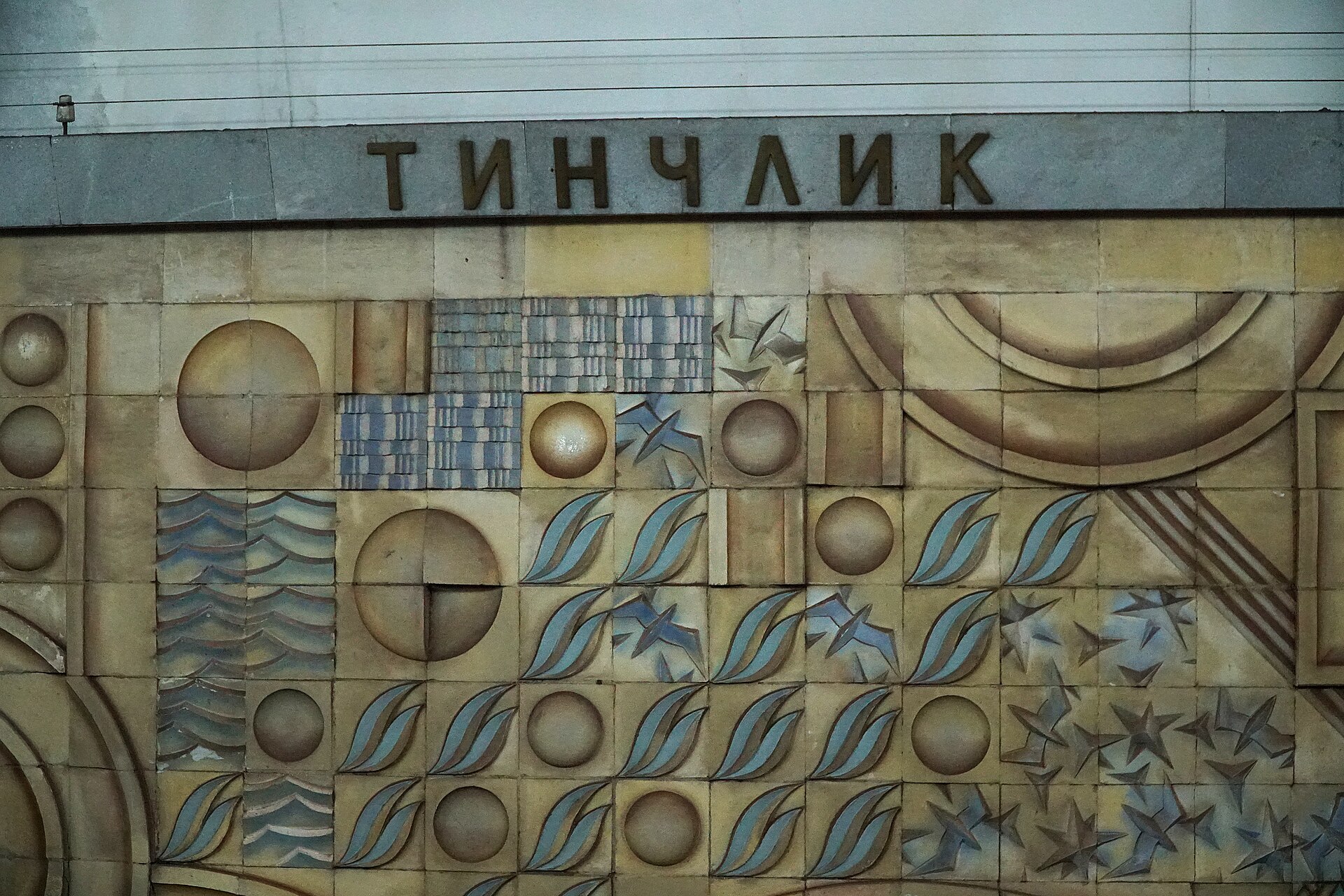
Tinchlik Metro Station
About the Object
Not established - period sources name the builders, not the designers
1991
Modernism
Западная часть Ташкента, на участке от «Чорсу» к жилому массиву Каракамыш
Railway Station
Gallery (1)

Launch without Fanfare
The Tashkent Metro was always commissioned in time for holidays. The first phase was launched on November 6, 1977; the second section was timed for Builder's Day; Tashselmash and Chkalovskaya for the metro's tenth anniversary; Gafur Gulyam and Chorsu again for the November holidays. Tinchlik became the station where the tradition ended. In August 1990, the newspaper still wrote cheerfully: the metro builders planned to commission the next station this year, Tinchlik, which means - peace. In September, it reported that finishing work and utility connections were in full swing at the new stations, and with their commissioning, the Uzbekistan Line would be fully operational; at the same time, it calculated that over the years of operation, the Tashkent metro had carried more than a billion passengers. And on November 1, 1990, an article was published under the headline - Launch... without Fanfare. Contrary to established tradition, on November 7 the Tashmetrostroy trust would not commission the new stations - the launch was postponed to the end of December. And further - a phrase that you will not find in Soviet construction chronicles: the stations are practically ready, the tunnels are not ready. An unprecedented case in the history of the trust. The chairman of the labor collective council, A. Krivolopov, explained - the very same man whose brigade was laying rails here two years ago. We are sitting at zero with many materials: no sleepers, no cement, an acute shortage of metal and timber. People come out for shifts and stand idle due to the lack of concrete, and you understand what their mood is; usually the pre-launch period caused a special uplift among workers, and now... He had to write a letter to the Chairman of当地 Council of Ministers of the republic asking for assistance. The reason was not the trust. The metro was classified as a city and republican construction project, the maintenance of the underground was shifted to the local budget, and the next year the metro builders were allocated eleven million rubles with a demand of twenty-seven to thirty. The Union Ministry of Transport Construction took a wait-and-see position: it had neither funds nor supplies. Trust manager G. Shtern said that the team of two and a half thousand people, which had been formed over the years and accumulated invaluable experience, was on the verge of a crisis, and specialists were already looking for work elsewhere. For the entire next year, the trust managed to conclude only one contract for the supply of materials. Despite all this, the stations themselves were mentioned in the same article surprisingly warmly: the builders did everything possible to bring the design of the architects and engineers to life, and Tinchlik and Beruni have their own unique look, they can be fully classified as -underground palaces-. Marble,ganch carving, modern lightweight materials and structures were widely used in the decoration. In December 1990, the station was not opened. It was opened on April 30, 1991, on the eve of May Day, and still two months ahead of schedule.
AI translation · 🇬🇧 EN
Rate this review:
A Name That Wandered Through Projects for Twenty Years
The word "tinchlik" means "peace" - not in the sense of the globe, but in the sense of the absence of war. In the Tashkent metro, it appeared long before this station actually came to be. In January 1969, "Pravda Vostoka" reported that the USSR Council of Ministers approved the design assignment for the construction of the metro in Tashkent, submitted by the Council of Ministers of the Uzbek SSR and the USSR Ministry of Transport Construction. The first line, 16.2 kilometers long with twelve stations, was supposed to run from "Dustlik" station to "Tinchlik" station, connecting the center with new residential areas and industrial zones in the southwest and northeast. In December 1971, a major feature was published on how this metro would be structured: shallow depth, open-cut method on seven sections, a seismic joint every fifty meters, rectangular cross-section boxes designed for nine magnitude earthquakes with a safety margin. And in the same piece - about the stations. It repeatedly mentioned "classic" Moscow layouts, but unusual ones would also appear in Tashkent: "Mukimi" and "Tinchlik". A huge expanse above the tracks and platform would be spanned by a continuous vault, no columns would be needed, and the monolithic reinforced concrete vault frame would be load-bearing. The decoration was also planned in advance: the grandeur of Lenin Square, the solemnity of Revolution Square, the theme of friendship of peoples at "Dustlik" station, and motifs of peace at "Tinchlik" station. An honest caveat is needed here. The metro was built for twenty-two years, and names in the projects moved from place to place. "Mukimi" never appeared in the Tashkent metro at all. Today, "Dustlik" is the name of a completely different station, the former "Chkalovskaya" at the eastern end of the second line. And the "Tinchlik" of 1969 was located at the end of the first line, meaning completely not where the current one stands. So a direct chain from that initial concept to this station cannot be drawn - one can only note that the name waited twenty years for its place and finally found it on a different line and in a different country. As for the construction itself, the tunnel toward "Tinchlik" began to be driven back in 1987: SMU-1 crews advanced toward it from a point a kilometer away from the "Moskva" Hotel, and the station itself was erected by one of the trust's best crews under the leadership of Lyuster. Three and a half years passed from the initial works to the launch.
AI translation · 🇬🇧 EN
Rate this review:
Nearby and related
By the same architect
Close by in Tashkent
About the Object
Not established - period sources name the builders, not the designers
1991
Modernism
Западная часть Ташкента, на участке от «Чорсу» к жилому массиву Каракамыш
Railway Station