
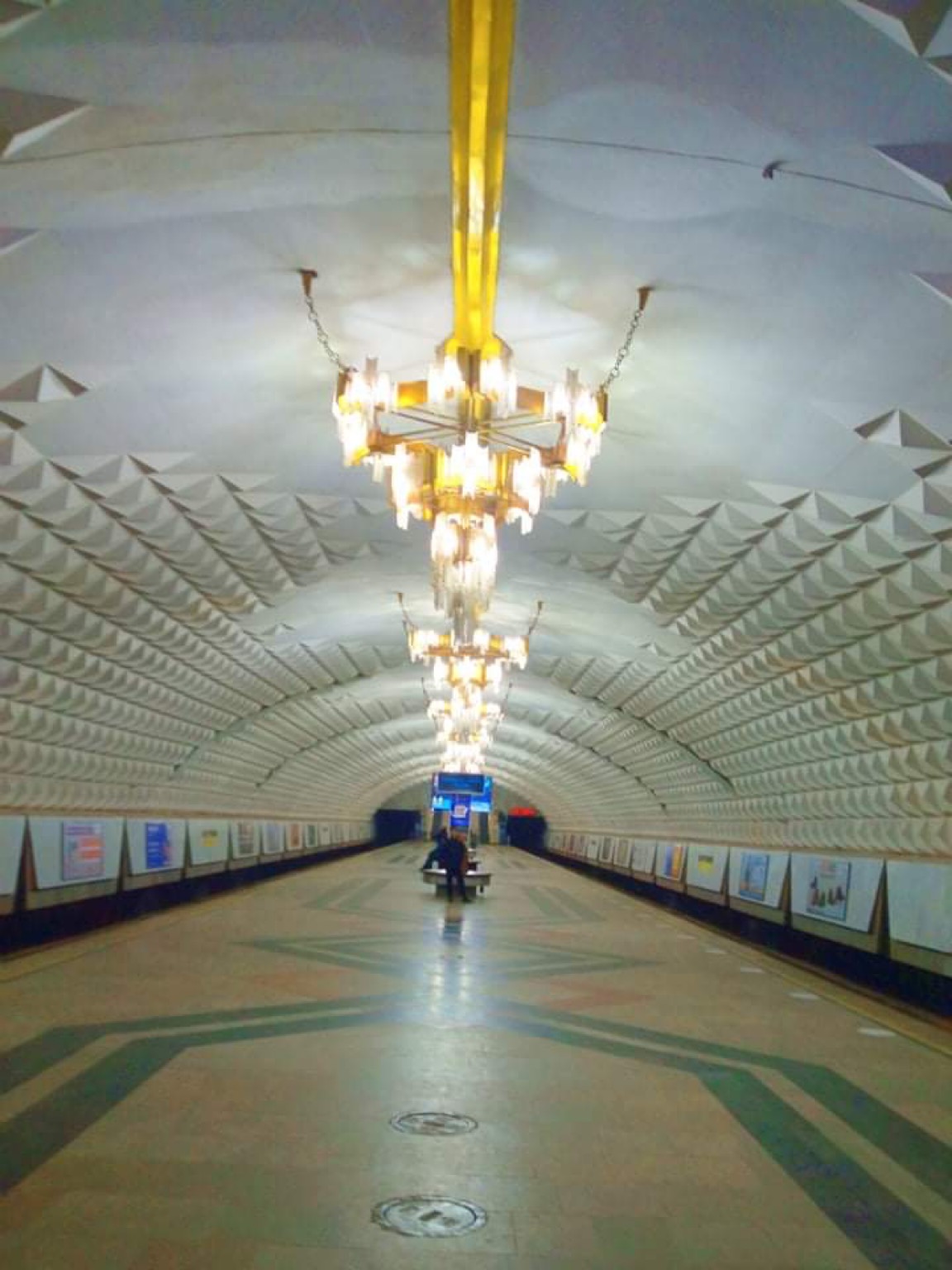
“Beruniy” Metro Station (Beruni)
About the Object
Not established - period sources name the builders, not the designers
1991
Modernism
Западная окраина Ташкента, у жилого массива Каракамыш; конечная станция Узбекистанской линии
Railway Station
Gallery (1)
Here Ended the Uzbekistan Line
The newspaper first wrote that the line would reach Beruniy in July 1987, in passing, within a note about transferring tunnelers to the section near Chorsu: trains would run here in 1989, and a year later traffic would open from Chorsu to Beruniy. The promise fell behind schedule by a year and a half. In August 1989, reporting on the early completion of the previous section, the newspaper clarified the meaning of the upcoming work: with the commissioning of the next two stations, Tinchlik and Beruniy, the construction of the Uzbekistan Line would be completed. In September 1990, photos were brought from the Beruniy construction site: finishing work and utility connections were in full swing. At the same time, it was estimated that over the years of operation, the Tashkent metro had carried more than a billion passengers. They planned to launch the stations by November 7, 1990, then postponed it to late December, and they opened on April 30, 1991, on the eve of May Day. The report was titled "The Uzbekistan Line is Completed." The eleven-year intense work schedule was finished by the subway builders two months ahead of schedule; regular traffic began between Chkalovskaya and Beruniy, meaning along the entire line from end to end. The last section, two stations and about four kilometers, was completed by metro builders in three and a half years. The meaning for the city was simple and great: residents of the Karakamysh residential area and the Medical Town got a direct route to the center and other districts without transfers, and students got a road to the university campus, where higher and secondary educational institutions, dormitories, and the Yubileyny Sports Palace are concentrated. The head of the Tashkent Metro, A. Mirdzhalilov, expected that fifty thousand people a day would use the two new stations, and said that the section was accepted with high reliability of all systems, and the designers and builders had worked well. By this day, the Tashkent metro had twenty-three stations and thirty-one kilometers of lines. On the same day, another event happened, which was mentioned in the report in a single paragraph: Tashselmash and Chkalovskaya, closed due to environmental violations, reopened. Metro executives reported that the situation had normalized and there were no reasons to worry about people's health, but environmental rehabilitation work would continue. So the day when the line was completed to the end became the day when it could be ridden entirely for the first time in a long time.
AI translation · 🇬🇧 EN
Rate this review:
Underground Palace in an Inopportune Year
The station is named after Abu Rayhan Biruni, an 11th-century Khorezmian scholar, astronomer, geographer, and mathematician, whose name in Soviet Uzbekistan was borne by a city, a district, the Republican State Prize, and the Tashkent Polytechnic Institute. For the metro, this name was in a way familiar: the Biruni Polytechnic was located on Navoi Street, near the station from which this branch was extended. Regarding what the station looks like, we have exactly one source - a note from November 1990, and it is generous with praise. The builders, it says, did everything possible to embody the design of the architects and engineers in the station decoration; both Tinchlik and Biruni have their own unique look, and they can fully be classified as "underground palaces," as Tashkent metro stations are often called. Marble, ganch carving, modern lightweight materials, and structures are widely used in the decoration. Ganch carving deserves special mention here: at the stations of the first line, they argued about marble and granite from specific deposits, at Chkalovskaya they made a sky out of aluminum, and here they returned to the traditional technique - and this was the last thing they managed to do. Because the year was unsuitable for underground palaces. Everything lies in the same newspaper issue. On the adjacent page to the launch report is the resolution of the CPSU Central Committee Plenum "On the situation in the country and ways to lead the economy out of the crisis." A week before the opening, in an issue with photographs of the finished stations, the metro management answered the question of what awaits the Tashkent metro in "pre-market" times: losses, apparently, will continue to be covered by subsidies, otherwise the metro cannot survive; in the first days of April, control at the stations was tightened and many "hare" fare-dodgers were identified; they were thinking of going to Minsk for experience - the local metro earned money by producing lipstick tubes. And a few days after the launch, the newspaper wrote that in April, due to a fare increase, the metro "lost" hundreds of thousands of passengers and tied its hopes for stabilization precisely to the new stations. Also in that same issue dated April 25, 1991, there is a photograph worth pausing at: Biruni station duty officer Elena Makhalina. The station is not yet open, there are no passengers, but the person at her post is already there. It was shot by Shavkat Ibragimov - the same photographer who shot the opening of Gafur Gulyam and Chorsu a year and a half earlier and the construction of Tinchlik and Biruni in the autumn of 1990. Biruni became the last station built in Tashkent under the Soviet Union. The next line, Yunusabad, was promised to be opened in 1995; it opened in 2001.
AI translation · 🇬🇧 EN
Rate this review:
Nearby and related
By the same architect
Close by in Tashkent
About the Object
Not established - period sources name the builders, not the designers
1991
Modernism
Западная окраина Ташкента, у жилого массива Каракамыш; конечная станция Узбекистанской линии
Railway Station