
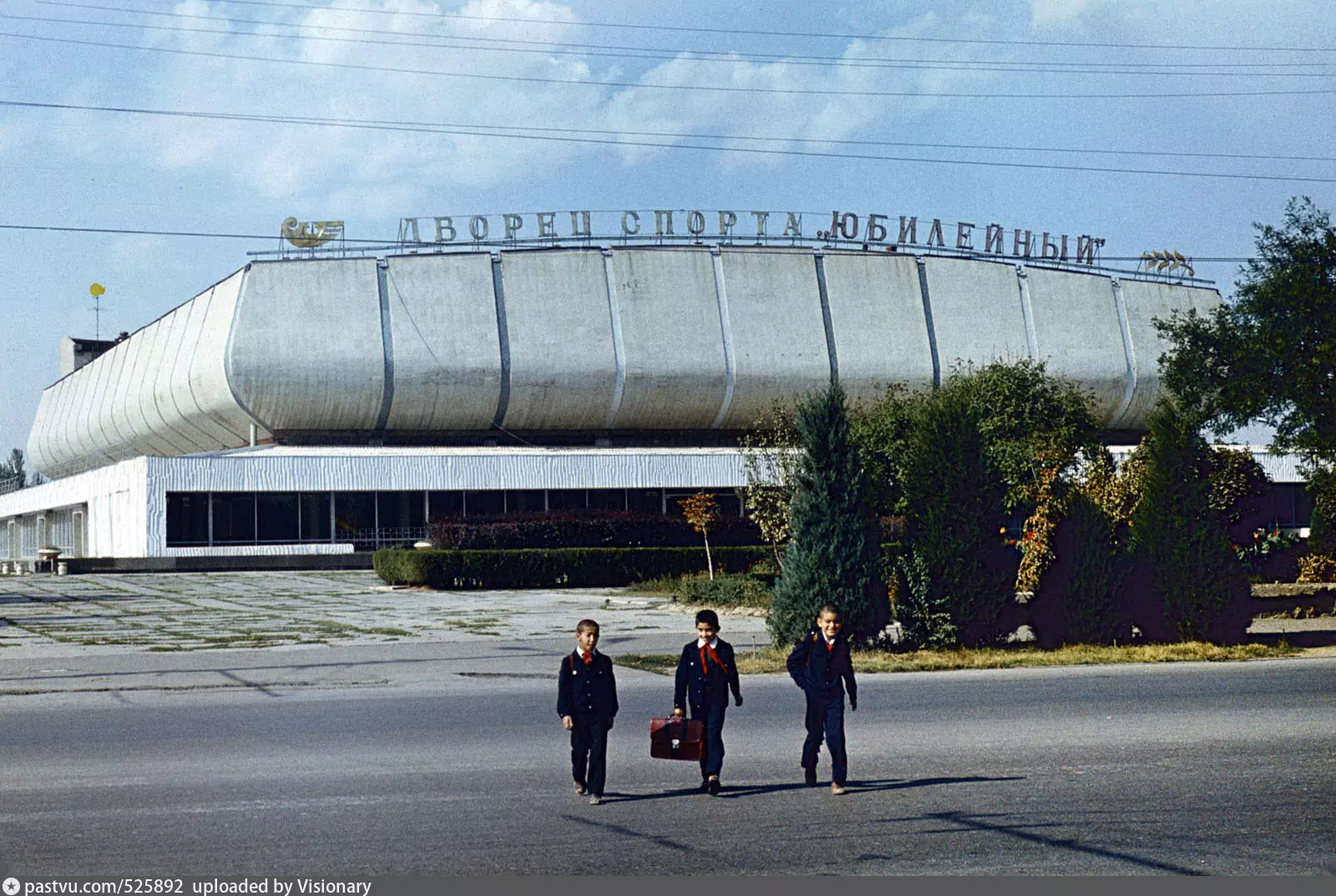
"Yubileyny" Sports Palace (Alpomish Ice Palace)
Частично утраченоAbout the Object
G. Aleksandrovich, O. Palieva (Tashgiprogor); typical design by Soyuzsportproekt; engineer V. Lazarev
1970
Brutalism
Проспект Беруни, у станции метро «Беруни», Ташкент
Public Building
Gallery (1)

Yubileyny: An Indoor Ice Rink in a City That Never Sees Winter
You are by the Beruniy metro station, in front of the Alpomish Ice Palace. You will no longer see the building that made it worth coming here: an indoor ice rink called Yubileyny stood on this spot and within these walls starting in 1970, and it acquired its current appearance during the remodeling of the 2000s. To begin discussing it, we must ask a question that has no clear answer anywhere: why did southern Tashkent need an ice palace at all? They based it on a standard design by Soyuzsportproekt, used to build rinks from Novosibirsk to Donetsk, taking the Alma-Ata variant adapted for nine-point seismic activity. Yet they reworked it so thoroughly that, compared to other rinks of the same series, the building looks like an entirely different type of structure. Architectural historian Boris Chukhovich calls it a unique monument to brutalism, believing this transformation happened when Genrikh Aleksandrovich, the lead architect of Tashgiprogor's first workshop, joined the project. The journal Architecture and Construction of Uzbekistan in 1974, listing the institute's major works, names the authors of the rink differently than usual: "the Yubileyny indoor ice rink (arch. G. Aleksandrovich, O. Paliyeva)." Olga Paliyeva stands as an equal in this list, and three years earlier the same journal presented her as the chief architect of the Yubileyny training rink project alongside engineer V. Lazarev. Thus, the building usually attributed to a single man was crafted by at least two people. Aleksandrovich wrote of his design: "The main volume of the auditorium has peculiar curved outlines... The illuminated volume of the hall will be clearly visible through the stained-glass windows of the foyer, seeming to float in the night sky." The concrete mass rested on the belt of the glass foyer and ceased to feel heavy; by day, the same effect worked inside, where sloping concrete planes hung in the air thanks to a strip of upper glazing. Around the building, a pedestrian bridge was thrown across a pool, an open-air chayhana shaped like an Uzbek sufa was installed, and a rose garden was laid out. The foyer, buffet, and government hall were adorned with woodcarvings by People's Artist of Uzbekistan Kadyrdzhan Khaidarov, a high-relief titled Hockey Players by sculptor Juozas Lipas appeared on the wall of the summer cafe, and Irena Lipiene's stained-glass piece Figure Skaters in the foyer featured yellow-red figures gliding over ultramarine ice. The name came last. In documents, the facility was simply called the indoor demonstration ice rink; in late 1968, Pravda Vostoka promised citizens ice by May 1, 1969, missed the deadline, and the following year happened to be the centenary of Lenin's birth. The rink opened in the spring of 1970, was elevated in rank to a Palace, and named Yubileyny. The hall accommodated between 3,700 and 6,400 spectators depending on the event: hockey, figure skating, gymnastics, volleyball, concerts, city celebrations. In the nineties, sports yielded to commerce, the palace filled up with retail stalls, and in the noughties it was rebuilt into an exhibition center pavilion. That is when the building lost itself: the historic facades and interiors were altered beyond recognition, and Yubileyny is on the list of lost monuments of Tashkent modernism precisely for this reason. In late December 2022, an ice palace opened here once again, now under the name Alpomish. The structure and function returned, but the architecture did not. So what is worth looking at here is not the building, but its history: how a standard project brought from Alma-Ata was turned by Tashkent architects into their own structure, and how that structure subsequently vanished without being demolished.
AI translation · 🇬🇧 EN
Rate this review:
Nearby and related
By the same architect
Close by in Tashkent
About the Object
G. Aleksandrovich, O. Palieva (Tashgiprogor); typical design by Soyuzsportproekt; engineer V. Lazarev
1970
Brutalism
Проспект Беруни, у станции метро «Беруни», Ташкент
Public Building