
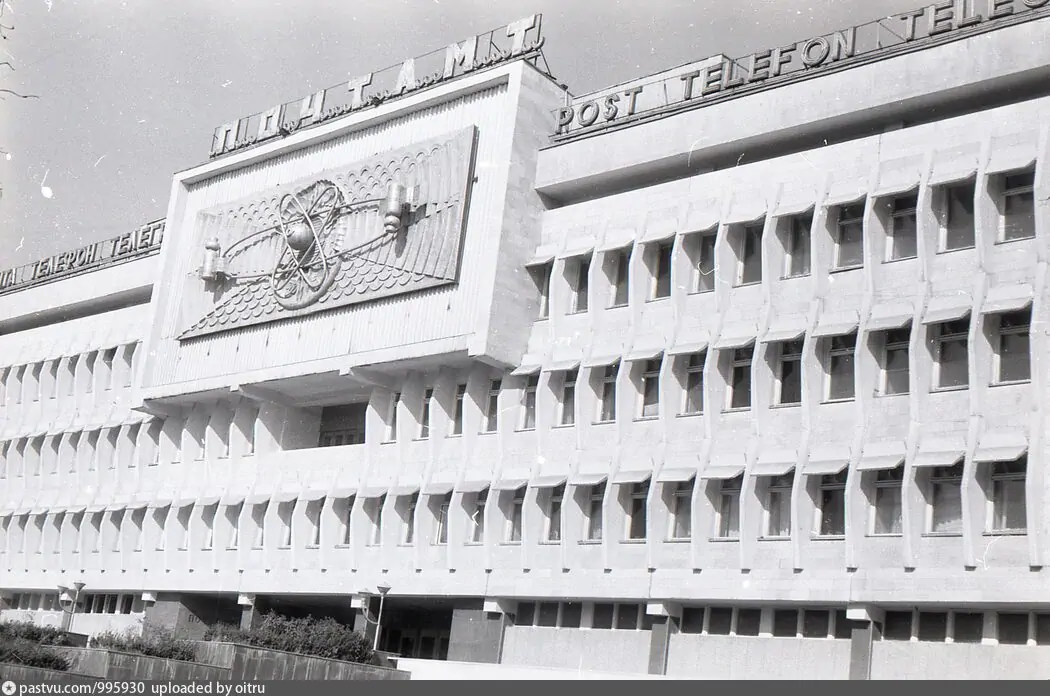
Main Post Office
Частично утраченоAbout the Object
G. Alexandrovich
1984
Modernism
Улица Шахрисабз, 7, Ташкент
Public Building
Gallery (1)

Main Post Office: a palazzo that can be brought back
The building you have approached is described briefly and aptly by German researchers of Tashkent architecture as a post office reminiscent of an Italian palazzo. It was built in 1984 based on a design by Genrikh Aleksandrovich. You have already encountered this name on the map, even if you did not pay attention: the same architect built the circus at Khadra. Colleagues remembered him as a man who, from the sixties to the nineties, guided the youth -on the path of true architecture, love for craftsmanship, and the highest culture of human relations- and said that many small buildings designed by his workshop bear the stamp of a respectful attitude toward the people they were intended for. Aside from the post office and the circus behind it, there is the complex of the Highway Institute and an entire residential district, Yunusabad. And now for the reason why this card is worth reading to the end. The facades of the post office were heavily altered by a late reconstruction - the building you see is dressed in a new layer. But researchers who measured it note something important: beneath this layer, the original structures have survived, and the original facades can be restored if desired. The building is not lost, it is hidden. There are not many such cases in Tashkent. Usually, alterations are irreversible: they strip things down, build extensions, and change proportions. Here, however, the old building is only partially damaged, and another layer has simply grown over the top. That means this palazzo has a chance that neither the Chorsu bathhouse nor the House of Cinema possesses.
AI translation · 🇬🇧 EN
Rate this review:
The Turquoise Promised in 1976
On January 11, 1976, 'Pravda Vostoka' listed what the city would begin building that year, and in a single line described the future post office: 'On the northwest corner of Engels and Pervomayskaya streets, construction will begin on the General Post Office building, original in its architecture (using traditional turquoise ceramics).' This is the earliest description of the building we have, and it was made eight years before the end of construction. Eight is not a typo. A reference note in the 1987 magazine 'Architecture and Construction of Uzbekistan' states briefly: 'Construction of the building was completed in August 1984.' Between the announcement and completion lay an entire five-year plan with a bonus. In the same footnote, everyone who worked on it is named: architects G. M. Alexandrovich (chief project architect) and G. V. Gutkina, engineers S. R. Berkovich (chief project engineer), O. I. Balunova, and Yu. V. Kalinin. It was built by construction trust No. 11 'Vysotstroy' of Glavtashkentstroy. This list is worth comparing with the circus at Khadra: the chief architect there was the same Alexandrovich, the chief engineer the same Berkovich, among the structural engineers the same Kalinin, and the general contractor the same trust No. 11 'Vysotstroy'. That means the post office and the circus are linked not by just one name, but by the same team and the same construction organization that moved from one site to another. How this construction was seen from the inside is preserved by a newspaper from the autumn of 1977. Brigade leader Khamid Karabaev spoke about himself as follows: 'I have been working in construction for thirty-three years, almost a quarter of a century of them on Tashkent construction sites. I erected residential buildings in Chilonzor, participated in the construction of the 'Uzbekfilm' film studio... In the ninth five-year plan, I built the building of the Higher Party School, the new television center, and now with my brigade we are finishing the construction of the fourth floor of the new General Post Office.' Five days later, the same newspaper explained what awaited this brigade next: it is 'mastering semi-automatic gas-shielded welding, for the first time in the practice of republican construction it will span the operational hall with 12-ton metal beams.' The operational hall is the very place where people come, and it had to be spanned without intermediate supports. For the sake of the twelve-ton beams, the brigade mastered a welding method that had not been used in construction in the republic before. The location of the building in the city is well thought out. The magazine writes that the post office 'is inscribed in the multi-story development system forming a peculiar cour d'honneur', that is, a front courtyard open to the street, and that due to this, 'a deep composition of a large urban scale' arises. The post office here is not a separate building, but the wall of the courtyard formed by neighboring high-rises. And finally, the reason why this card is worth keeping next to the first one. The first overview says that the current facades are a late layer, and the original structures beneath them are intact. What exactly this original layer was cannot be said from our sources: the 1987 article in the body breaks off, its description of the facades has not reached us. But the concept is recorded in the newspaper in January 1976, and the turquoise ceramics are named directly in it. Restoring the building, if it comes to that, will not start from a blank slate.
AI translation · 🇬🇧 EN
Rate this review:
Nearby and related
By the same architect
Close by in Tashkent
About the Object
G. Alexandrovich
1984
Modernism
Улица Шахрисабз, 7, Ташкент
Public Building