
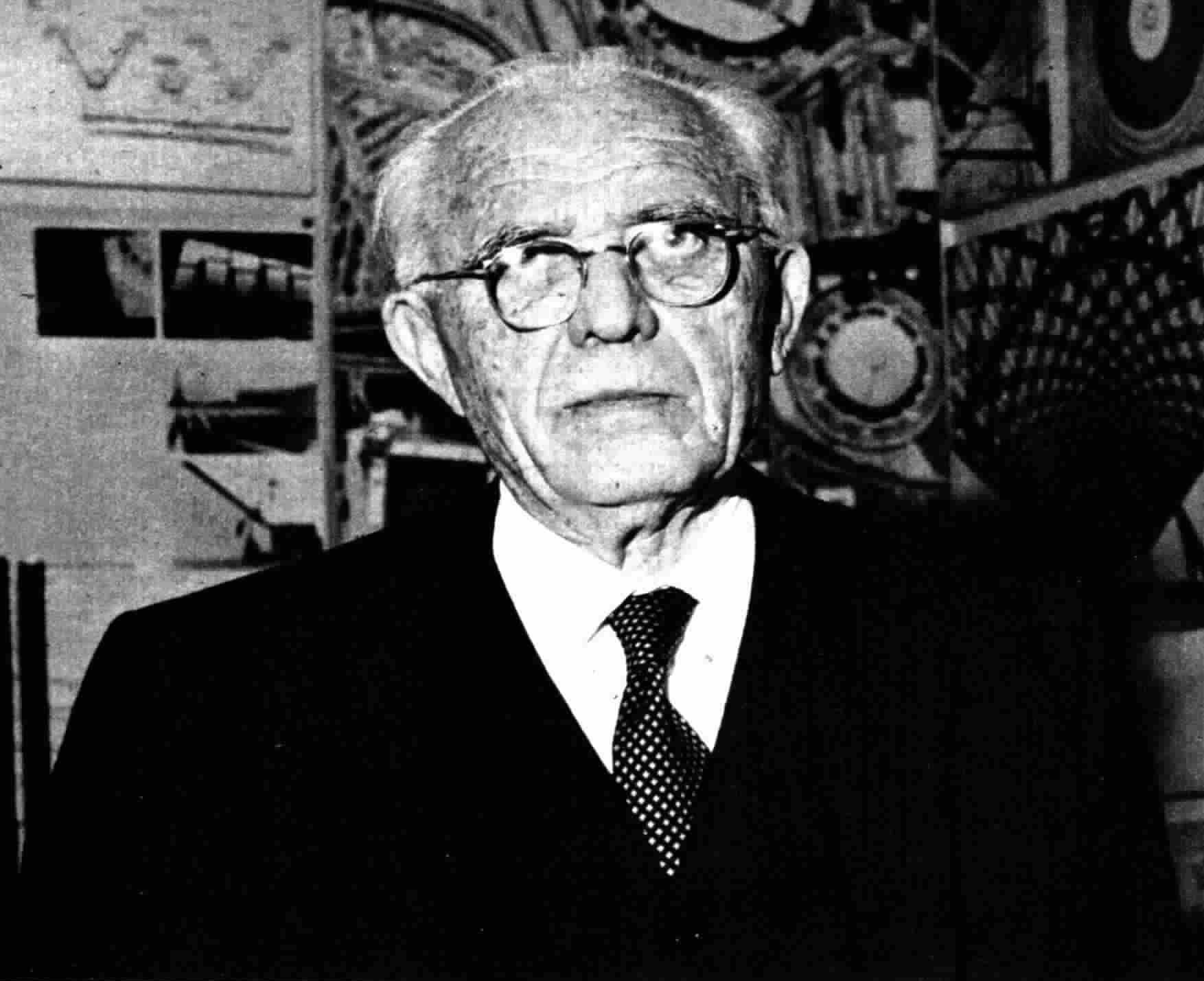
Pier Luigi Nervi
About the Object
Pier Luigi Nervi
1891
Other
Piazza Apollodoro, Flaminio, Roma
Historic Personality
Gallery (1)

The engineer whose structure is architecture
The dome behind you is assembled from one thousand six hundred and twenty prefabricated concrete elements and erected in forty days. Pier Luigi Nervi conceived this, and in his case, the usual division into an "architect who came up with the pretty design" and an "engineer who did the math" simply does not work: the beauty of his buildings is their calculation. He lived a long life, from 1891 to 1979, and perfected his method long before his Roman fame. In the late 1930s, he built concrete hangars for the Italian Air Force. The vaults there were supported by a grid of light, intersecting ribs, and these ribs were cast in advance as separate pieces and then assembled. The result was a pattern resembling a diamond lattice-exceptionally durable and very beautiful. Just how durable became clear by chance: in 1944, retreating German forces tried to blow up the hangars, and most of the nodes where the ribs converged survived. From this experience grew the Roman Palazzetto. Prefabricated components, a ready-made rib pattern, construction taking weeks instead of months, bifurcated supports placed on the outside so that the interior of the hall remained clean and circular. His true hour of triumph struck in 1960 when Rome hosted the Olympics. Lejeune writes that the Games became a national and international apotheosis for Nervi-recognition as one of the greatest engineers and structural designers of his century. For the Games, he built the Stadio Flaminio right here in the Flaminio district, and then solved a problem that seemed to be about traffic but turned out to be urban planning: he elevated the traffic flow above the ground, turning Corso Francia into a viaduct resting on a series of masterfully sculpted concrete piers. The ground was freed from traffic, and the two halves of the Olympic Village were reconnected. It is also worth remembering what he did not build alone. The Palazzetto was created together with architect Annibale Vitellozzi, and the large Palazzo dello Sport in the EUR district together with Marcello Piacentini. Nervi almost always worked in pairs: he was responsible for the structure, his co-author for the building. And one last thing. When, after the war, someone had to vouch for Piacentini-an architect who had built for the regime-Nervi was among those who testified on his behalf. Lejeune writes about this in his analysis of the Via della Conciliazione. A small detail, but it shows the weight of this name: the engineer's word meant something not just on the construction site.
AI translation · 🇬🇧 EN
Rate this review:
Nearby and related
By the same architect
Close by in Rome
About the Object
Pier Luigi Nervi
1891
Other
Piazza Apollodoro, Flaminio, Roma
Historic Personality