
Lorenzo Ghiberti
About the Object
Lorenzo Ghiberti
c. 1378
Other
Piazza San Giovanni, Firenze
Historic Personality
Gallery (1)

The Man Who Spent Half a Century on One Set of Doors and Twice Left His Face on Them
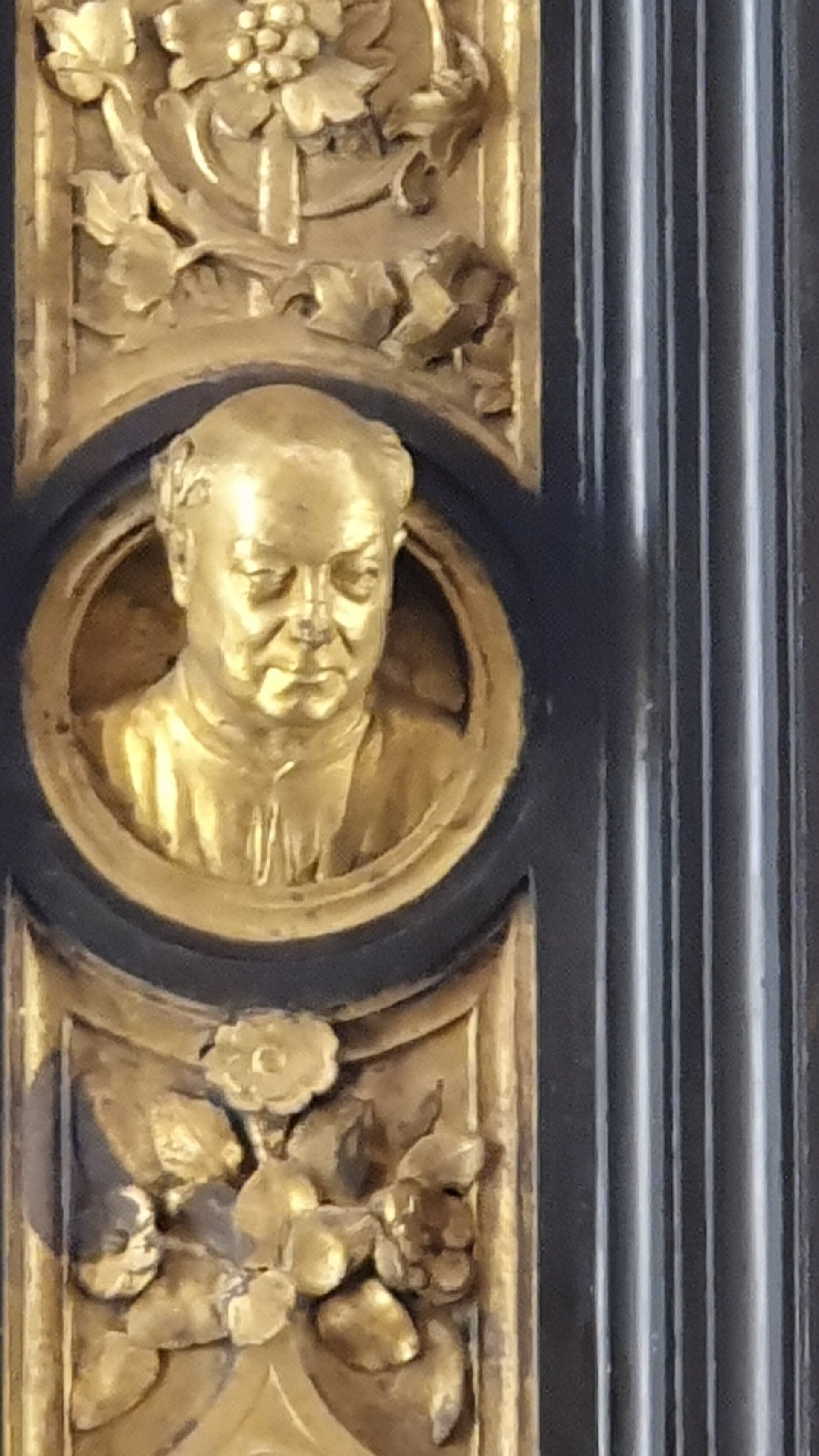
Before you stands the Baptistery, and upon it are the doors that Florence still argues about. The doors themselves are described in the Baptistery guide. Here is about the man who gave fifty years of his life to them. Let us start with his name, for things are not entirely simple with it. In 1370, Lorenzo's mother married a certain Chione Ghiberti - a man from a decent family, but, according to contemporaries, "completely worthless, pitiful, almost losing his mind." A few years later she fled from him to Florence and began living with the goldsmith Bartolo di Michele; they married only after Chione's death in 1406. Lorenzo's exact date of birth is unknown, as is the date of his mother's flight, and therefore the main thing is unknown: whose son he is. For a person of that era, this was not a domestic question, but a social one - illegitimacy closed doors. He learned his craft in his stepfather's workshop, meaning as a goldsmith. In 1400, fleeing the plague, he left the city; he writes about this himself in his "Commentaries" - an autobiography, a rarest thing for an artist of that epoch: "In my youth, in the year of the birth of Christ 1400, I left here because of the epidemic that appeared in Florence, as well as the misfortune that befell the homeland." A year later he returned, won the competition for the Baptistery doors - and never did anything major in Florence again, because there was no time to do so. Do the math. He made the first doors for twenty-odd years and installed them in 1424. As soon as they were installed, the Arte di Calimala ordered the second ones - this time without a competition, just for him. The second ones took twenty-seven years: he started in 1425, declared them finished in 1452. Half a century for two doors, and with that life essentially ended: he died in 1455 and was buried in Santa Croce along with his sons Vittorio and Lorenzo, who were his assistants. Now for the reason to come close here. On both doors Ghiberti hid his own portrait. On the first doors, in the framing, he sculpted forty-seven small heads - prophets and prophetesses, old and young, calm and agitated. But one head, the third from the bottom in the middle of the left leaf, is clearly a Renaissance man: a middle-aged man with heavy eyelids, shaved full cheeks, and a fashionable turban. It is him. Nearby is the signature: OPUS LAVRENTII FLORENTINI, "the work of Lorenzo of Florence." On the second doors he placed himself in almost the same spot - and this is already a different man. A wise, kind, old face, a bald head, and it is placed with obvious irony: right where the door handle should be. Between the two portraits lies thirty years of one work. And the signature on the second doors is different: LAVRENTII CIONIS DE GHIBERTIS - "Lorenzo, son of Chione Ghiberti." For many years he signed simply as "Lorenzo," without a patronymic, and that was convenient: this way the question of birth legitimacy did not arise. And from 1442 he begins to call himself the son of Chione - and it is under this name that we know him today. Historians suggest that sometime around then the question of his origin was nevertheless asked aloud, and he chose the answer. It remains to say what is not visible on the doors. Ghiberti's workshop was the main school of the city: virtually all Florentine sculptors and painters of the next generation passed through it. The man who won a single competition and then spent half a century on a single commission turned out to be the teacher of an entire epoch.
AI translation · 🇬🇧 EN
Rate this review:
Nearby and related
Close by in Florence
About the Object
Lorenzo Ghiberti
c. 1378
Other
Piazza San Giovanni, Firenze
Historic Personality