
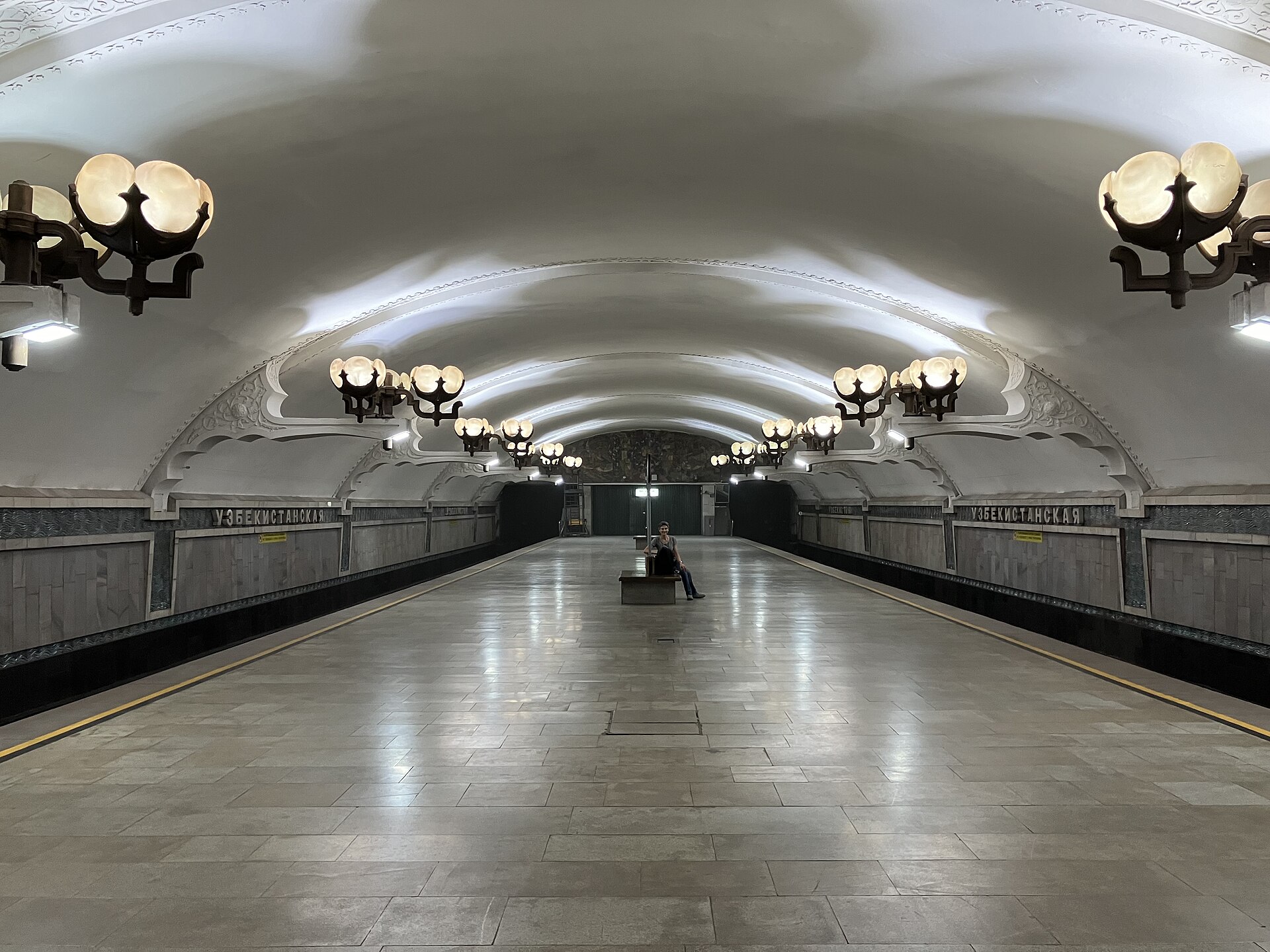
Uzbekistanskaya Metro Station
About the Object
Architects S. Adylov (head), A. Tabibov, Ya. Mansurov, F. Muzaffarova, R. Fayzullaev (chief project architect), Tashmetroproekt; artists V. Dudin (lamps in the form of cotton bolls), A. Bukharbaev (florentine mosaic panels at the ends of the platform)
1984
Modernism
Пересечение улицы Новоузбекистанской и проспекта Космонавтов, близ здания Узбекбрляшу и Центрального стадиона «Пахтакор» (АиСУз № 5, 1982)
Railway Station
Gallery (1)

The only one in the republic
In mid-eighties Uzbekistan, there was precisely one artist working in Florentine mosaic, A. Bukharbaev. It is stated plainly in the 1985 issue of Architecture and Construction of Uzbekistan: he, as the republic's sole artist working in this technique, was commissioned to create monumental decorative mosaic panels. The list of commissions that follows shows the level of these projects: the interior of the V. I. Lenin Palace of Friendship of Peoples, the Uzbekistanskaya station of the Tashkent metro, and finally, the new TV tower. The three main construction projects of the republic, and the exact same person, because there was simply no one else to do this work. It is worth explaining why this is a rarity. Florentine mosaic is not smalt. A smalt panel is assembled from many small pieces of glass, and the image is formed from patches like pixels. In the Florentine technique, fragments are cut from various types of stone along the contour of the drawing and fitted closely together without seams, so the surface turns out smooth and solid, and the color is provided by the stone itself. The tradition comes from sixteenth-century Florence, the work is like jewelry, and it takes years to master. Bukharbaev's first work in this technique for the metro was the panel at the Khamza station on the first line, and a 1977 magazine noted that Florentine mosaic was being executed in Uzbekistan for the first time then. Uzbekistanskaya is a continuation of that same line: at the new station, the panels were once again entrusted to him. At the same time, this explains why there are so many different techniques in the Tashkent metro of the seventies and eighties - smalt, copper chasing, ganch carving, bronze reliefs, Florentine mosaic. Each station was an excuse to utilize a craft that only a handful of people in the republic mastered, and sometimes just a single person. Uzbekistanskaya itself is a single-vaulted, shallow-foundation station - only eight meters below the surface - with two underground vestibules and a 102-meter-long island platform. The design is gathered around two themes, cotton and water: the glass and metal lighting fixtures are made in the shape of an open cotton boll, and the ceramic panels depict flowing water; the vault is complemented by ganch carving. The materials are marble, granite, ceramics, ganch, metal, and glass.
AI translation · 🇬🇧 EN
Rate this review:
The Station That Sparked Debate
The Uzbekistan line opened in December 1984, connecting the city center from the Pakhtakor and Alisher Navoi stations to the main railway station. Uzbekistan station is one of the stations from this first phase. In June 1985, the magazine Architecture and Construction of Uzbekistan dedicated an entire issue to discussing the new stations, featuring speeches by architects, artists, metro builders, and operators, along with excerpts from questionnaires. We do not have this issue at our disposal, and we do not know exactly what was said about Uzbekistan station back then. However, we do know what the professional community's opinion was two and a half years later. In February 1988, the same magazine gathered another discussion for the launch of the Tashselmash and Chkalovskaya stations, and the reviewer began their walk through the new stations with a phrase that says it all: when launching the first phase of the second line, it seemed that nothing could be worse than Uzbekistan station; it turns out, something could. That is, by 1988, Uzbekistan station served as a benchmark in the professional environment, as the station than which, it was believed, nothing worse could be made. At the same time, a mass survey painted a more complex picture. In December 1987, 255 experts - professors and students of the architecture faculty, employees of Tashgiprogor, UzNIIPgradostroitelstva, and TashZNIIEP, as well as historians, archaeologists, and journalists - evaluated nineteen stations on a four-point scale. The author of the publication singled out five stations as the most controversial, where the spread of ratings did not match the final ranking: Alisher Navoi, Chilanzar, Pakhtakor, Tashkent, and Uzbekistan. That is, there was no consensus here either: some gave high ratings, others low. It is worth citing the general conclusions of that survey, as they are good in their own right: non-author architects evaluate the work of colleagues strictly, sometimes even harshly; women are generally more loyal than men, with the difference for some stations reaching 0.4 points. The next stage was planned to be a survey of workers and employees of two large industrial enterprises in the zone of the new stations, meaning those who ride rather than those who design. Our corpus does not tell how this ended.
AI translation · 🇬🇧 EN
Rate this review:
Nearby and related
By the same architect
Close by in Tashkent
About the Object
Architects S. Adylov (head), A. Tabibov, Ya. Mansurov, F. Muzaffarova, R. Fayzullaev (chief project architect), Tashmetroproekt; artists V. Dudin (lamps in the form of cotton bolls), A. Bukharbaev (florentine mosaic panels at the ends of the platform)
1984
Modernism
Пересечение улицы Новоузбекистанской и проспекта Космонавтов, близ здания Узбекбрляшу и Центрального стадиона «Пахтакор» (АиСУз № 5, 1982)
Railway Station