
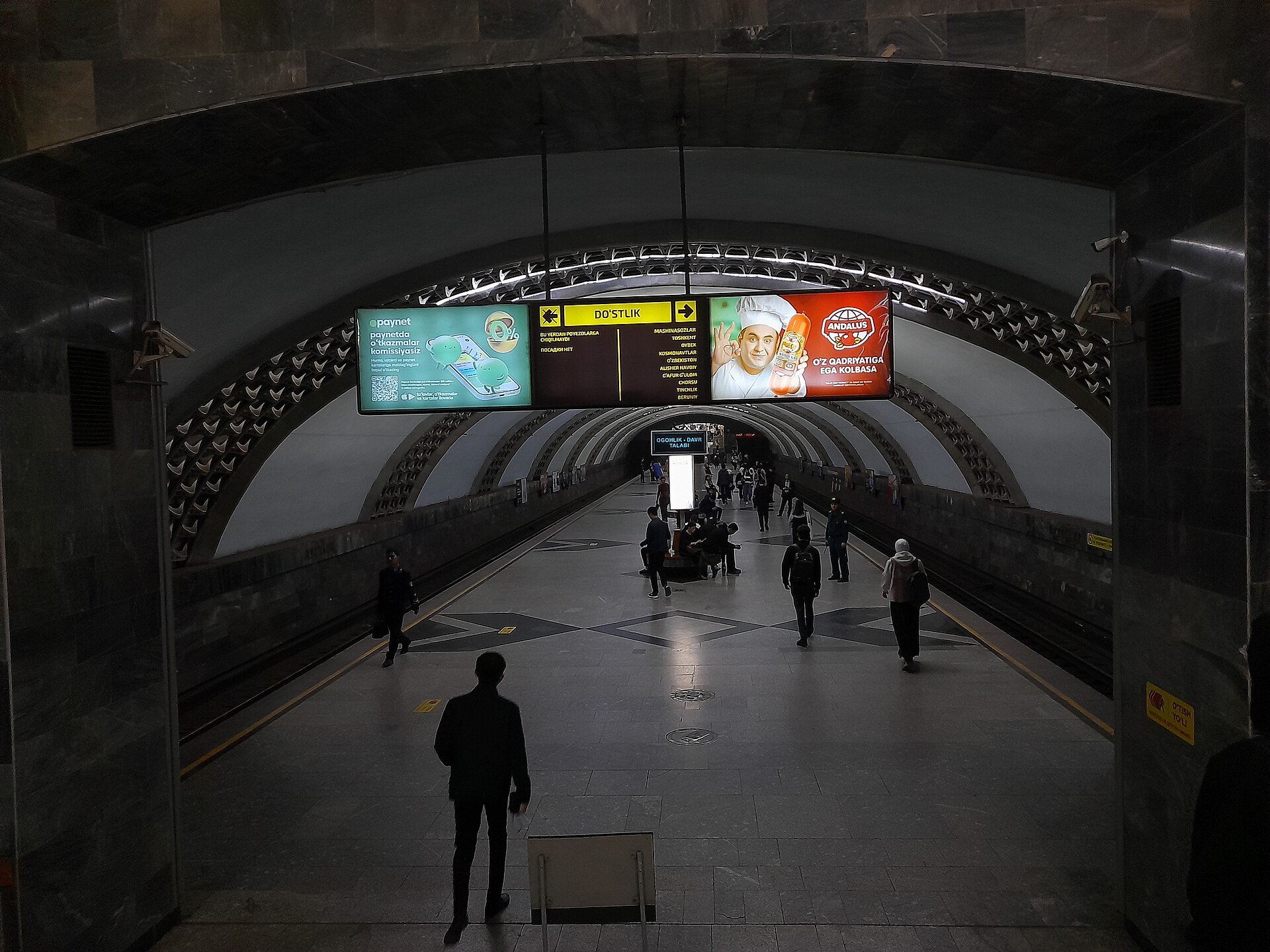
“Do‘stlik” Metro Station (Chkalovskaya)
About the Object
Architects O. Aydinova, A. Dashkevich, B. Kurbankhodzhaev; engineer Yu. Falkevich
1987
Modernism
Северо-восточный промышленный район, у Ташкентского авиационного производственного объединения имени В. П. Чкалова (АиСУз № 2, 1988)
Railway Station
Gallery (1)

Sky Assembled from Aluminum
The station is dedicated to aviator Valery Chkalov, and the authors made this not a theme for a panel, but the principle upon which everything is built. The idea is formulated in a magazine as follows: the vaulted space of the station is conceived associatively, as a blue dome of the firmament with cirrus trail-plumes from modern aircraft. The lighting is arranged accordingly: built-in ceiling fixtures made of aluminum fade toward the edges, like a cirrus airplane trail melting toward the horizon. Not a panel with an airplane on the wall, but the ceiling itself, which reads as the sky. Next is the material. The main finishing material of the station is aluminum, and it was chosen for a dual reason: it is an aircraft-building material and at the same time an architectural-decorative one. In the metro, where marble and granite are customary, the lightweight metal looks like a statement of principle. At neighboring stations of the line, walls were faced with stone from various deposits and argued over shades; here they took what airplanes are made of. The logic extends even to the furniture. The indicator bench was specially designed around the station theme, as a metal sculpture made of aluminum, in which the indicator lamp holder is shaped like a radar. The authors also explained the overall restraint of the solution: concepts such as courage, precision, and conciseness are characteristic of aviation, which is why they strove for a solution extremely restrained in general and extremely concise in details. This is a rare case for the Soviet metro when the absence of decor is declared as content, rather than economy. The station was designed by architects Ofelia Aidinova, A. Dashkevich, and B. Kurbankhodzhayev, engineer Yu. Falkevich.
AI translation · 🇬🇧 EN
Rate this review:
Chkalov, Gagarin and the opinion of colleagues
Through the widely opened arched openings from the platform, the end walls of the lobbies are visible, and both of them are occupied not by decoration, but by text and a portrait. On one is a panel with a bronze bust of Chkalov, erected in honor of the USSR-USA transarctic flight. The date is important here: the fiftieth anniversary of this flight was widely celebrated by the American and Soviet public in June 1987, that is, a few months before the station opened. The station was built in the very year when Chkalov's flight was remembered on both sides of the ocean. On the other wall, in lobby number 2, are the words of Yuri Gagarin about his teacher: "Aviation is the cradle of astronautics. And the traditions born by pilots are developed and multiplied by cosmonauts. In stellar distances, the deeds of Chkalov, the name of Chkalov will live." It turns out to be a link across the entire city: on another line of the Tashkent metro, the "Prospekt Kosmonavtov" station has been operating since 1984, and there the same theme is deployed in the opposite direction - from the sky to space. Now about how the station was met. The issue of the magazine from which we know all this was debatable: the editorial board specially invited specialists to evaluate the two new stations, and the evaluations turned out to be harsh. The reviewer - an architect whose surname in our copy goes into the binding - wrote that the vault here brings to mind a gloomy sky full of threatening electricity, which Valery Chkalov so fearlessly stormed; that the station seems significantly shorter than the previous ones due to the strips of light fixtures crossing the vault transversely; that these stamped aluminum light fixtures emphasize the flabbiness and inelasticity of the vault, rather than hiding it, as was successfully done at the "Hamza" station. The floor pattern also got criticized, as well as the gloomy dirty-gray color of the vault plaster, and the facing of the track wall, where an unsuccessful selection of stone, in his expression, gives it the appearance of rough unfinished work. The reviewer praised the lobby - and noticed exactly the same thing as at "Tashselmash": the lobby is designed significantly better than the station itself. The round columns on the transit directions of entrance and exit are especially good; the combination of round and square cross-section columns gives the interior dynamics, dryness disappears, and the warmth of the architect's hand is felt. There was also a sociological survey in the same issue: in December 1987, 255 experts - teachers and students of the architectural faculty, employees of design institutes, historians, journalists - evaluated the architecture of nineteen stations on a four-point scale. "Chkalovskaya" and "Tashselmash" were evaluated by only about half of the respondents: the stations were too new, many simply had not seen them. The author of the publication honestly stipulated that the places of these two stations in the table are tentative. Today the station is called "Dustlik" - "friendship". The pilot's name is gone, but the sky on the vault remained.
AI translation · 🇬🇧 EN
Rate this review:
The Station They Refused to Drive Trains To
One and a half years after opening, Chkalovskaya became a station where train traffic was halted because of the air. In the spring of 1989, train drivers and station workers began visiting doctors complaining of nausea, dizziness, headaches, and dryness and soreness in the throat. On April 14, Pravda Vostoka published their letter with fifty-three signatures under the headline - Toxic waste floods the Chkalovskaya metro station; the authors wrote about the cover-up of harmful working conditions, and UzTAG reported a dangerous leak of chromium solutions. In May, a response arrived with two signatures and stamps: the General Director of the Tashkent Aviation Production Association V. Zhuravlev and the Head of the Tashkent Metro Sh. Shaabdurakhimov shared the collective's concern and listed measures - control over the collection, removal, and disposal of chromium-containing electrolytes, systematic sampling of air and water together with the city and railway sanitary-epidemiological services, a special ventilation regime with two units operating continuously for exhaust, and round-the-clock dewatering wells. By August, measurements at the station still showed excess maximum permissible concentrations: nitrogen dioxide - 3.8, phenol - 3.3, ammonia - 2.3, hydrogen sulfide - 1.6, hydrogen chloride - 1.2. The head of the metro's labor safety sector G. T. Sagatov would later tell the newspaper something that made the whole story read differently: the metro had paid attention to the unhealthy ecological environment in the area of the Chkalov aviation association back in 1985, which was two years before the station was opened here. On Saturday, September 2, 1989, train drivers, apologizing to passengers, turned their trains back two blocks before the terminus. This was a warning action. On the same day, the city party committee bureau created a commission of representatives from Goskompriroda, the sanitary-epidemiological service, and aircraft manufacturing engineers, and the city executive committee urgently launched buses to the aircraft plant instead of trains. From September 5, there was no traffic on the polluted section at all: about fifty thousand trips a day were disrupted on the stretch. Rumors crept around the city - about an accident, about the ground failing to support the trunk line. The cause was sought for two months. The newspaper called this - ecological consequence - unprecedented in the history of the world metro. A - bank of versions - was created, with each studied separately: gas surveys at the plant and along the tunnel were conducted by Krasnokholmskgeologia, studies were carried out by Uzhydromet, the Tashkent branch of VNIIVodgeo, Sredazgiproniigaz, the Institute of Nuclear Physics, the Institute of Chemical Technology of the Ministry of the Medical Industry, the Research Institute of Forensic Science, and the Institute of Chemistry. Experts from the All-Union Research Institute of Railway Hygiene made a diagnosis: acute occupational poisoning by a complex of gases. On November 9, 1989, the trains returned. The article was called - Victory in the ecological conflict, - but the deputy chairman of the republic's Goskompriroda, V. Konyukhov, who headed the commission, immediately warned that the investigation was not over and other tunnels, stations, and underground structures of Tashkent had to be checked. He was right: the station was closed once more. In the first quarter of 1991, both Chkalovskaya and Selmashskaya were down, and the newspaper mentioned this while reporting that the Tashkent underground turned out to be the best in the country for the quarter and that this did not come easy. They opened on April 30, 1991, on the eve of May Day, on the same day as the launch of Tinchlik and Beruni, which completed the entire Uzbekistan Line. The report on this stated dryly: both stations were closed due to environmental violations, metro leaders believe that the situation has normalized and there is no reason to worry about people's health, but environmental rehabilitation work will continue. The station stood closed for the second time, and the coincidence turned out to be expressive: the day the line was completed to the end became the day it was returned to full operation. The most unexpected version was proposed by an insider of the metro - the head of the chemical corrosion laboratory Mikhail Tabachnikov. He noticed that the gas concentration in the tunnel grew twice a year, in March-April and September-October, and that at one of the control points the mercury column almost reached sixty degrees in winter. Neither fit the technogenic version. Then Tabachnikov took water seeping through the concrete wall of the new fuel and lubricant warehouse, separated the petroleum products, and separated them into fractions by distillation - gasoline, kerosene, and oils were obtained. Crude oil is divided this way. There were fifty grams of it in a liter of water. Hence the conclusion: condensate of gaseous petroleum fractions rises along the earth's crust faults, and the deposit itself may lie tens or even hundreds of kilometers from Tashkent. About the station itself, the same article stated harshly and to the architectural point: a hastily designed tunnel blocked the groundwater flow, and the accumulation of petroleum products near the man-made underground jumper created an environment for microorganisms, whose waste products are gases. Biogeochemical processes in groundwater destroyed the station's waterproofing. It was impossible to simply pump out the water: powerful pumps would have created a depression cone, and with it the risk of subsidence of the metro itself and buildings within a radius of several kilometers. In the autumn of 1991, the newspaper summed up, and it was bleak. The medical station at the station and the road clinic registered more than seven hundred appeals from Chkalovskaya workers and train drivers; four were taken away by ambulance. The metro was closed twice, and both times, the correspondent wrote, not upon the recommendation of the environmental commission or by decision of the administration, but under pressure from rank-and-file workers and train drivers. Thousands of tons of contaminated water were pumped out from under the station daily, and corrosion monitoring systems at Chkalovskaya never appeared. Tabachnikov, who proposed digging a lake in the path of the underground channel to collect groundwater, when asked by a correspondent what was holding it up, asked a question in return: who will pay for this? - and resigned. The station dedicated to flight received the most terrestrial history in the entire Tashkent metro.
AI translation · 🇬🇧 EN
Rate this review:
Nearby and related
By the same architect
Close by in Tashkent
About the Object
Architects O. Aydinova, A. Dashkevich, B. Kurbankhodzhaev; engineer Yu. Falkevich
1987
Modernism
Северо-восточный промышленный район, у Ташкентского авиационного производственного объединения имени В. П. Чкалова (АиСУз № 2, 1988)
Railway Station