
Mashinasozlar Metro Station (Tashselmash)
About the Object
Architect A. Adylova; artist V. Gan; foreman of the facing brigade A. Askerov; chief project engineer A. Zakirov
1987
Modernism
Вблизи завода «Ташсельмаш», северо-восточный промышленный район (АиСУз № 2, 1988)
Railway Station
Gallery (1)

The Station That Was Supposed to Sing an Ode to Labor
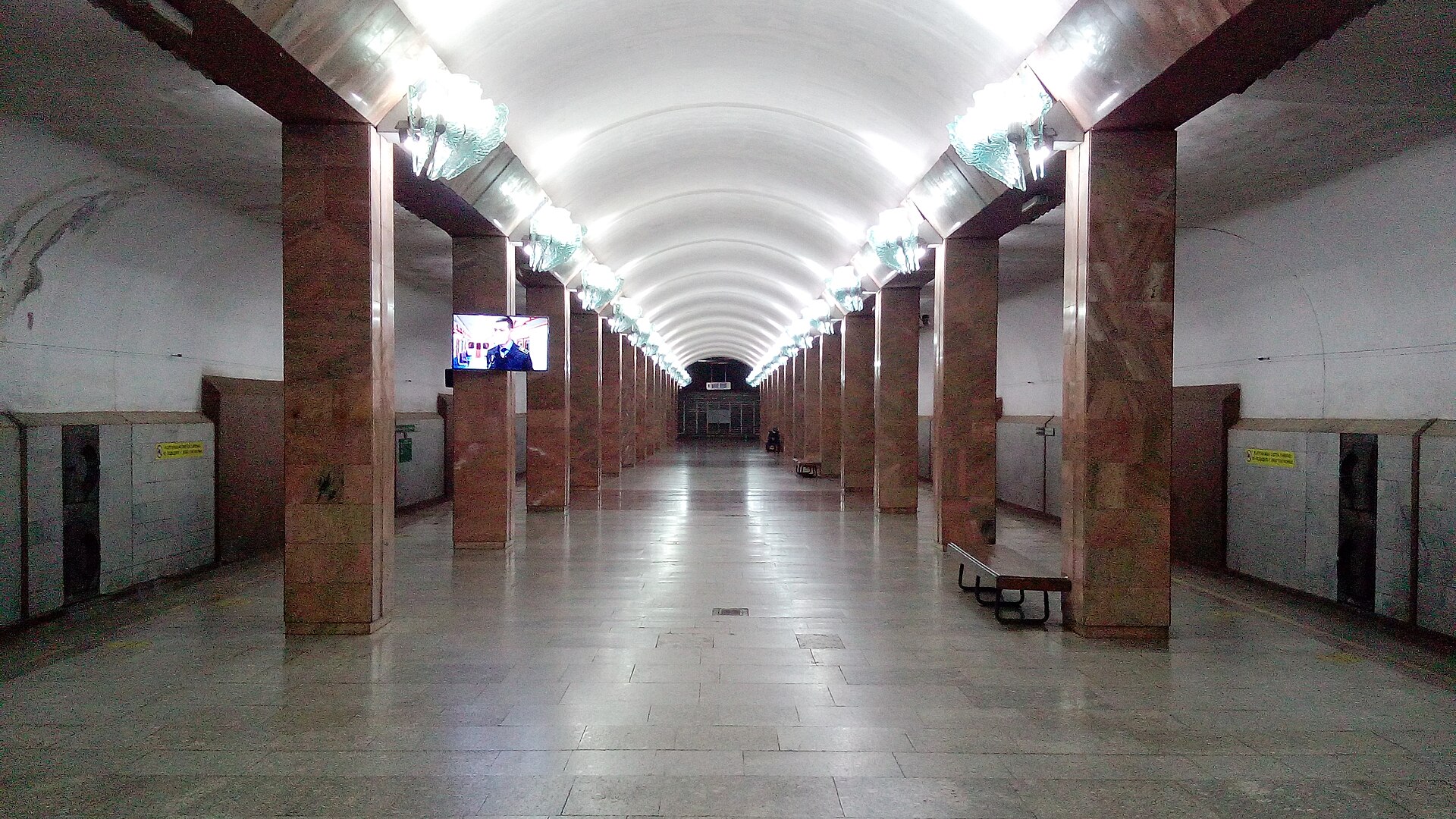
In November 1987, the Tashkent Metro turned ten, and two new stations on the Uzbekistan Line, Tashselmash and Chkalovskaya, were opened to mark the date. The line reached the north-eastern industrial district and connected it to the center. Tashselmash stands near the agricultural machinery plant of the same name, and the name determined everything else. The project's author, architect A. Adylova, explained the concept directly in a magazine: the station's color scheme was dictated by its name, as she wanted the station to "sing" an ode to the labor of the plant's workers. structurally, they took the standard precast column scheme, the same one used at Aybek. But several things were done for the first time in the Tashkent Metro here. The platform and lobbies received a unified compositional and color solution, even though their ceiling structures are different; between the lobbies and the platform, the "lobiki" were removed, those very portals that in previous stations separated one space from another. The lobby ceilings were lined with a suspended aluminum grille so that the difference in structures would not stand out. And for the first time, service rooms in the lobbies were arranged asymmetrically to properly manage the incoming and outgoing passenger flow. The platform is arranged as three naves: a solemn central one and two auxiliary ones. Sconce lights above the columns of the central nave emphasize this solemnity, while the lighting from the track walls side is hidden behind decorative glass placed flush with the transom cladding. Further on, the author's text begins what rarely gets into print: a list of what did not work out. The columns are faced with pink and green Burovshchina marble from the Sayano-Shushenskoye deposit, but there was not enough material, so the upper part of the transoms remained unfaced, and the "flags" on the track walls had to be made of Emelyanovo granite. On the "flags", the station name and the hammer and sickle were placed as a symbol of the alliance of workers and peasants - and they, Adylova writes, unfortunately, were made by the plant itself, rather than the Sculpture Combine of the Ministry of Culture. Decorative glass for the light fixtures was made by artist V. Gan at the Kuvasay Glass Factory, and the ministry joined the work not in April 1987, but in August, three months before launch, so there was no time left for experiments. Separately, Adylova mentions a controversial detail: many architects are confused by the turquoise color of the lamp glass, but she feels that the artist managed to convey the movement of fresh wind and fresh greenery and merge into that very ode to labor. This station has another rarity. The fixture mounts and stainless steel handrails were made by the designers and workers of the Tashselmash plant itself, and A. Askerov, the foreman of the comprehensive cladding brigade, was included in the author's team. The architect explains it this way: his attitude to the station's design was creative, with his work he competently completed what was conceived by the project. A worker included in the author's team on equal terms with the architect and artist is a rare occurrence in Soviet architectural press.
AI translation · 🇬🇧 EN
Rate this review:
A Smashing Critique in Its Own Magazine
Normally, Soviet architectural magazines wrote about new metro stations uniformly: the design, materials, authors' names, and the word "successful". The February 1988 issue of "Architecture and Construction of Uzbekistan" is structured differently, and that in itself is a historical document. The editorial board announced a discussion, invited specialists to evaluate two new stations, and complained in the preface that people still take a very long time to resolve to have an open and honest conversation in print. It was specifically noted that "Tashmetroproyect" (Director Khalmuradov), the republic's only institute of its kind, refused to participate in the discussion for the reason that their attitude toward metro architecture is unequivocal. And then in that very same issue, a few pages after the author's article about "Tashselmash", comes a review by another architect, written like a walk through the station. It begins this way: when launching the first phase of the second line, it seemed that nothing could possibly be worse than the "Uzbekistanaskaya" station; as it turns out, something can. Moving on in order. The milky-white lobby is acknowledged by the author as a success - laconic, clean, and tasteful. But as soon as you step onto the main staircase and notice the wall sconces "slovenly made from cheap glass of a monstrous shade", a languid sense of discomfort arises. The platform is described as a drearily gloomy stone-columned hall. The granite of the columns, the color of red-lead primer, writes the reviewer, "is successfully set off by the tender-green, untidy, cabbage-like leaves of the lamp-capitals" - precisely those turquoise fixtures that the project's author defended. The most malicious part is about the hammer and sickle. The memorial plaques on the track wall, adorned, in the reviewer's expression, with a crude hammer and sickle, are treated in such a way that they evoke memories of cemetery fences painted with silver paint; while the modest inscription "Tashselmash" nearby suggests that this is precisely where the plant is buried. Having walked ten steps, you notice that it was "buried" once more, in the exact same "grave", and that several more such "tombstones" lie ahead, and on the opposite wall as well. In all fairness, the reviewer also notes what was done well: stainless steel pipes for the stair handrails, as well as a composition of pipes and glass in one of the lobbies that does not conflict with the interior, even if it does not address the station's theme as straightforwardly as the hammer and sickle. Read back-to-back, these two texts provide what makes reading old magazines worth it at all: you can see the design, its implementation, and what contemporary colleagues thought of the result. The station in which the author heard a hymn to labor sounded like a requiem to the reviewer. At the same time, a survey of experts conducted in December 1987 and published in the same issue did not really evaluate "Tashselmash": the station was too new, and less than half of those surveyed had seen it. Today the station is called "Mashinsozlar" - the same word as "Tashselmash", just in Uzbek and without the factory's name.
AI translation · 🇬🇧 EN
Rate this review:
Twice the end of the line
A year and a half after opening, the station made history having almost nothing to do with architecture, and stopped working for a long time. Trouble came from the neighboring Chkalovskaya, the next and last station on this section. In the spring of 1989, its workers and drivers began to complain of nausea, dizziness, and headaches; experts from the All-Union Scientific Research Institute of Railway Hygiene diagnosed acute occupational poisoning by a complex of gases rising into the tunnel from contaminated groundwater. On Saturday, September 2, 1989, the drivers, apologizing to passengers, turned the trains back two stretches before the terminal, and from September 5, traffic beyond Tashselmash stopped completely. The city executive committee launched buses to the aviation plant instead of the subway, and for two months Tashselmash became the last station of the line. Trains returned on November 9, 1989, after two months of what a newspaper called an unprecedented ecological consequence in the history of the world metro. It did not end there. In the first quarter of 1991, Pravda Vostoka, reporting that the Tashkent metro was recognized as the best among the country's subways, made a reservation: this was not easily achieved, because for environmental reasons two stations were closed for traffic - Chkalovskaya and Selmashskaya. They were opened on April 30, 1991, on the eve of May Day, on the very day when Tinchlik and Beruni were launched and the Uzbekistan line was completed to the end. The metro management reported that the situation had normalized and there were no reasons to worry about people's health, but environmental rehabilitation work would continue. In the autumn of the same year, the newspaper wrote that the metro was closed both times not on the recommendation of the environmental commission and not by the decision of the administration, but under pressure from rank-and-file workers and drivers. It turns out to be a sad rhyme with the expert survey. In December 1987, Tashselmash could not be properly evaluated because the station was too new and few people had seen it. And a year and a half later it was closed, and there was nowhere to see it. Details of the accident are in the Chkalovskaya card: the cause was sought for two years, five hypotheses were considered, and they reached the assumption that there is oil under Tashkent.
AI translation · 🇬🇧 EN
Rate this review:
Nearby and related
By the same architect
Close by in Tashkent
About the Object
Architect A. Adylova; artist V. Gan; foreman of the facing brigade A. Askerov; chief project engineer A. Zakirov
1987
Modernism
Вблизи завода «Ташсельмаш», северо-восточный промышленный район (АиСУз № 2, 1988)
Railway Station