
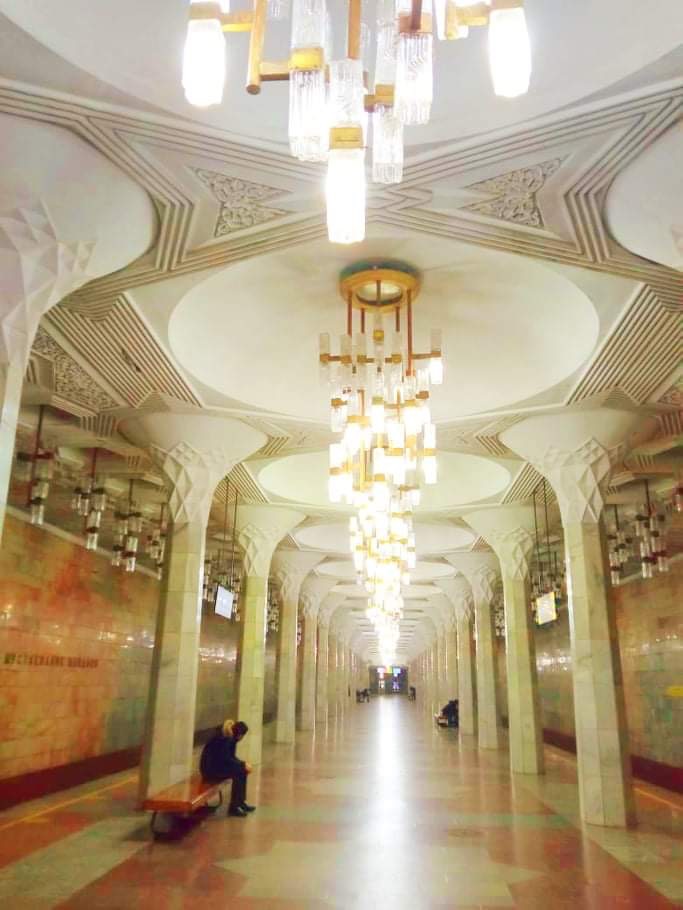
Mustaqillik Maydoni Metro Station
About the Object
L. Adamov, A. Adylova, L. Popov, S. Adylov (Tashmetroproekt and Metrogiprotrans); sculptor Ya. Shapiro (relief panel); artist I. Lipene (chandeliers)
1977
Postmodernism
Yunusabad district, Tashkent, 100029, Uzbekistan
Railway Station
Gallery (2)

Mustakillik Square Metro Station
We descend underground to the Mustakillik Square metro station. It belongs to the very first phase of construction of the Tashkent Metro and was originally named after Vladimir Lenin. Architects Leonid Adamov, Laurence Popov, and Sabir Adylov proposed a completely unconventional semi-underground solution here. The platform hall is connected by stairs and escalators to two ticket halls, one of which was above ground. The main feature of this station is that its meaning and scale are conveyed not through applied decor, but through the architecture itself. The slender, light octagonal columns here are taller than on typical standard stations. They support a ceiling assembled from openwork ribbed panels, which creates a feeling of incredible spaciousness. Look up to the center of the hall. Unique crystal chandeliers, resembling heavy bunches of grapes, are suspended from the large and small domes of the ceiling. Sketches for them were created by the renowned artist Irena Lipene. In Soviet years, the ideological direction of the station was set by a bronze inscription about the friendship of peoples and a large relief panel by sculptor Yakov Shapiro. Today, this decor is a thing of the past, and the exit to the surface is preceded by the new Arch of Good Intentions. Interestingly, this station became a place of engineering triumphs. During the tunneling towards the neighboring Pakhtakor station, builders first applied a unique rock compression method. This allowed for saving tens of tons of cement and reducing hundreds of working days. Furthermore, it boasts the most pleasant microclimate in the entire metro system. Field studies in the 1980s showed that it is the coolest station during summer heat. The secret is simple: directly above our heads is a green park area and cascades of fountains, which prevent the ground from overheating. Professionals have always highly valued this architectural ensemble. In 1987, according to an anonymous survey among architects, this station took an honorable second place for beauty, yielding the palm only to the famous Kosmonavtlar station.
AI translation · 🇬🇧 EN
📷 https://ru.wikipedia.org/wiki/%D0%9C%D1%83%D1%81%D1%82%D0%B0%D0%BA%D0%B8%D0%BB%D0%BB%D0%B8%D0%BA_%D0%BC%D0%B0%D0%B9%D0%B4%D0%BE%D0%BD%D0%B8_(%D1%81%D1%82%D0%B0%D0%BD%D1%86%D0%B8%D1%8F_%D0%BC%D0%B5%D1%82%D1%80%D0%BE)#/media/%D0%A4%D0%B0%D0%B9%D0%BB:Ornament_on_the_Independence_square_station.jpg
Rate this review:
What was here in 1977
The magazine described this station in the month of its opening, and that description shows how much has vanished from here since then. It is worth starting with the address. The station was placed at the intersection of two axes: the boulevard that begins at Revolution Square and continues into the central park zone beyond the Parade Alley, and Lenin Avenue. Accordingly, the exits faced: one toward Parade Alley, the other toward F. E. Dzerzhinsky Square. Neither name exists on the city map anymore. The lobby on the Parade Alley side was made combined with an underground pedestrian crossing beneath Lenin Avenue, and it turned out to be very large. The magazine names two reasons: a large flow of passengers had to be passed through the city center - and the station was projected to be an interchange one. This second part did not come true. In 1977, two stations of the first line at once were described as future interchange ones: Pakhtakor and Lenin Square. At Pakhtakor, the interchange was built in advance, and in 1984 it began operating. Lenin Square never became an interchange - not a single subsequent line ever came here. The large lobby remained simply a large lobby. The magazine lists the finishes by materials: the rectangular columns of the ticket halls smoothly merge with the walls, both faced with Gazgan marble; the light fixtures are recessed into the bottom of the ribbed ceiling slabs and directed at the polished granite floor. Below, on the platform, are slender white columns of Nurata marble and light pink walls of Gazgan marble. Crystal chandeliers are suspended along the perimeter of the ceiling, and the middle of the hall culminates in domes with large stalactite crystal chandeliers, which give the hall a solemn appearance. The author of the artistic solution for the chandeliers is I. Lipene. And two things that do not exist today. Above the entrance from Dzerzhinsky Square, there was a monumental art panel. And in the niche between the entrance and exit to the lobby stood a bronze bust of Vladimir Ilyich Lenin - not usually mentioned, but named directly by the magazine in the same list with the chandeliers and marble. The magazine connects the concept of the hall not with the metro, but with the city above: the idea of the platform hall, it writes, is closely connected with the ensemble of the city center, with its administrative and cultural complexes, with the central Parade Alley, ending with a majestic monument to the leader of the revolution. That is, the station was built as an underground continuation of the square. The square has changed twice since then, and the station along with it.
AI translation · 🇬🇧 EN
Rate this review:
The only station everyone had an opinion on
In December 1987, the magazine Architecture and Construction of Uzbekistan distributed questionnaires to Tashkent architects: a list of nineteen metro stations, evaluated on a four-point school grading system - excellent, good, satisfactory, poor. 255 questionnaires were processed. Lenin Square station took second place with an average score of 4.639. Kosmonavtov Avenue came in first, by a noticeable margin. But there is a detail in the table that is easy to miss. Opposite each station, it shows how many people evaluated it at all, and almost nowhere is this number equal to 255: someone hadn't seen the station, someone found it difficult to answer. Aybek was evaluated by 225 people, 50 Years of USSR by 232, and the two new 1987 stations, Tashselmash and Chkalovskaya, by just over a hundred and twenty each, meaning half of the respondents. For Lenin Square, this column shows 255. Out of nineteen stations, it is the only one that was evaluated by every single person, without a single omission. Everyone who took the questionnaire had an opinion about it. The scores themselves: one hundred eighty "excellent", sixty-one "good", eleven "satisfactory", and three "poor". Three negative reviews out of two-five-five people is the second best result after the winning station, which had none at all. The author of the survey, explaining the results, also noted a structural reason. He expected vault-type stations to win: a single solid space, it seemed to him, better serves the function of a transit hub. It turned out the other way around - all the prize-winning places were taken by column-type stations, and the vaulted ones were located in the middle of the table. And he spoke separately about Lenin Square: here the column structure differs in height, the same as at the Alisher Navoi station, which took fourth place. The height of the hall turned out to be what professionals valued most of all. Decades later, part of what the station was evaluated for has disappeared: the panels, the bronze bust, the inscription about the friendship of peoples. The columns and the height remained, and judging by the table, that was the main thing.
AI translation · 🇬🇧 EN
Rate this review:
Nearby and related
By the same architect
Close by in Tashkent
About the Object
L. Adamov, A. Adylova, L. Popov, S. Adylov (Tashmetroproekt and Metrogiprotrans); sculptor Ya. Shapiro (relief panel); artist I. Lipene (chandeliers)
1977
Postmodernism
Yunusabad district, Tashkent, 100029, Uzbekistan
Railway Station
Visitor Information
$ 0,2