
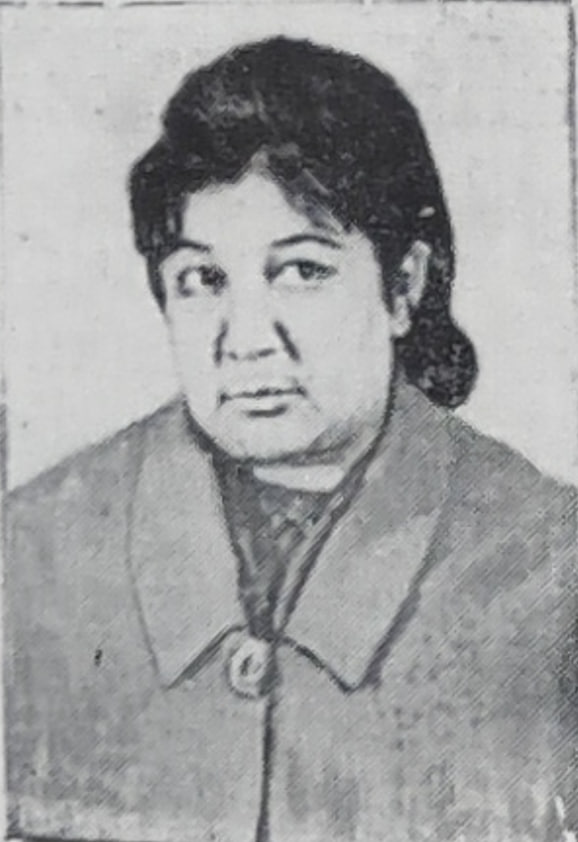
Ofelia Petrovna Aydinova
About the Object
Ofelia Petrovna Aydinova
1927
Other
Historic Personality
Gallery (1)

Ofelia Aidinova
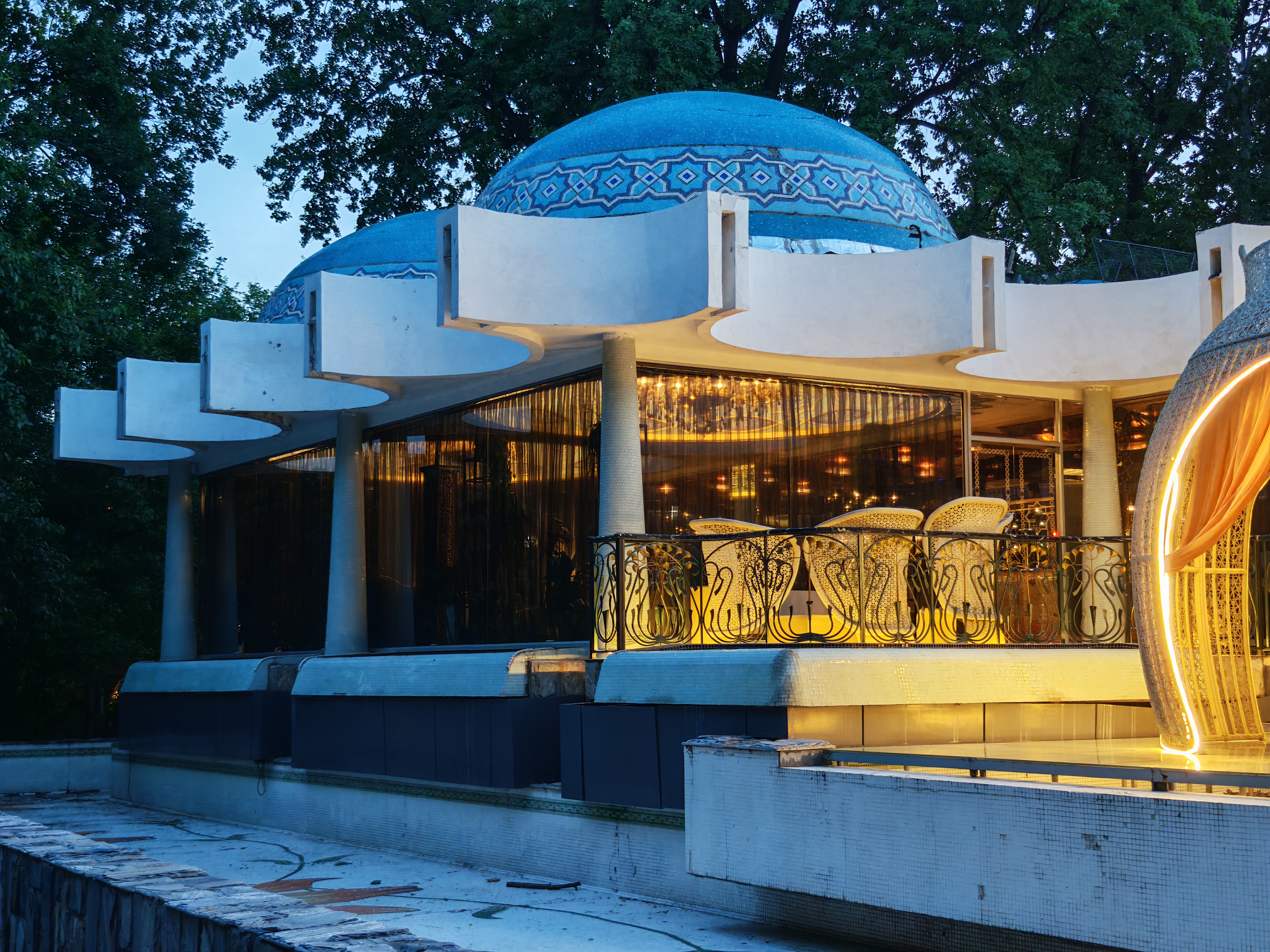
You are standing by a building that was largely conceived by one woman. Meet Ofelia Petrovna Aidinova, lead architect at the TashZNIIEP institute and author of the "Zhemchug" (Pearl). Even among Tashkent's many prominent female architects, her figure stands out as extraordinary. She was born in Tashkent in 1927 into an Armenian family with a complicated history. Her father, Petros Aydinyants, was forced to flee to the Turkestan region from the Ottoman Empire shortly before the tragedy of 1915, and her mother, Maryam Davidyants, moved here in 1920 from Nagorno-Karabakh. In 1950, Ofelia graduated from the architectural department of the Central Asian Polytechnic Institute and devoted herself to the most down-to-earth aspect of the profession: housing. She started not with towers, but with rural settlements in the Golodnaya Steppe. She designed houses without walk-through rooms, where the living quarters were adjoined by an aywan-that very summer loggia without which an Uzbek house is not a home. For this series, the young architect was awarded a first-degree diploma at an all-Union review. And in 1960, she designed one of the country's first nursing homes-about twenty such buildings were constructed across the republic based on her project. True fame came with hotels. Starting in 1964, Aidinova led the high-rise Intourist hotels in Samarkand and Bukhara as chief architect. In the "Bukhara" hotel, she combined the techniques of ancient Uzbek architecture with modern materials, and in 1977 she became one of the first women to be awarded the Hamza State Prize. For a female architect of that era, this was the pinnacle. And her life's work became the "Zhemchug" (Pearl). At TashZNIIEP, the institute of experimental and standard housing, architects sought a home that would suit the lifestyle of an Uzbek family and the hot climate; several projects of "complex-houses" with shared courtyards remained only on paper. Only Aidinova managed to bring the idea of the "vertical mahalla" from concept to construction-and "Zhemchug" became her experiment, the building she loved more than any other. Her long-standing creative and friendly tandem with architect Saveliy Rosenblum was jokingly dubbed "Ofeblum" by colleagues. And the flat roof of the 16th floor turned into a vibrant club: on summer evenings, artists, architects, journalists, and writers would gather there. Ofelia Petrovna is no longer with us, but "Zhemchug" stands-a pride of the Tashkent architectural school and a monument to its creator.
AI translation · 🇬🇧 EN
Rate this review:
What They Wrote About Her While She Was Working
The first mention in a republican newspaper dates back to August 9, 1950, and it lacks both her name and patronymic. "Pravda Vostoka" reports on the new Directorate for Rural and Collective Farm Construction, whose workshops "are staffed mainly by young engineers and architects, graduates of the Central Asian Polytechnic Institute." Among them: "Architects Rutkovsky, Kryukova, and Aidinova are working on designs for various types of collective farm clubs. Construction of clubs in a number of agricultural artels in the Yangi-Yul District is planned based on these designs." She is twenty-three years old, graduated from the institute this same year, and the first thing published about her is not housing, but clubs. Fourteen years later, she is written about as an author. In September 1964, Ilya Agranovsky writes about the Intourist Hotel and casually mentions something that explains the scale of the work: "this design, with minor changes, will become standard for Central Asia." The design was divided among cities: "Architects F. Levinshtein and L. Ershova for Ashgabat and Dushanbe, and architect O. Aidinova for Samarkand and Bukhara." And already here is a detail that we will have to return to: the elevator "will take you to any floor and even to the roof of the hotel, to the city observation deck." In February 1965, she speaks for herself. Standing next to the model of the Samarkand hotel at the corner of Akhunbabaev Street and Maxim Gorky Boulevard, the chief project architect explains the concept: "The ten-story hotel will have 820 rooms with all amenities. The ground floor will house service bureaus and restaurants. The roof will be flat. This is a gallery from where guests will be able to survey the city." Next comes the only question that in Tashkent in 1965 was more important than beauty: "- What about seismicity?" The answer is: "Everything is provided for. The first two floors are a monolithic reinforced concrete structure. The rest are made of large panels from the Samarkand House-Building Plant. For the first time in Uzbekistan, a high-rise building will be erected from panels." A panel high-rise in a seismic zone was then not a standard method, but an experiment, and she was the one conducting it. The same article names her institute colleagues: the Bukhara version with 500 rooms and the twenty-story Tashkent hotel, 54 meters high, under the leadership of the institute's chief architect, I. A. Merport. And a line about the future: the institute "is currently developing designs for high-rise residential buildings of 9 and 16 floors. Sixteen floors will appear in a magazine ten years later. AiSUz for 1975, issue six, captions a drawing as follows: "Experimental 16-story residential building made of monolithic claydite concrete, erected in sliding formwork. Chief project architect O. Aidinova." In February 1979, the building is already under construction: "Authors O. Aidinova and P. Levin from the TashZNIItEP institute," and next to the architects, installers Vyacheslav Ishkov and Alexander Grib are named. Between these dates, on August 9, 1978, a report on the award is published, and its wording is more precise than usual: "For the monumental interior design of the Bukhoro Hotel, its authors - architect O. Aidinova and a group of Samarkand artists E. Aliev, N. Banzeladze, V. Degtyarev, A. Dzhishiashvili, S. Rakova, N. Prashchenko - have been awarded the Hamza State Prize." That is, the prize was shared between the architect and six artists, and was given for the interior: for the "Kupkari" and "Rest" compositions in the lobby, copper repousse work, and a depiction of ulak - a folklore equestrian game. Her last work written about by the press is underground. In 1982, AiSUz shows the design of the Chkalovskaya station near the Chkalov Aviation Association, where a complex two-level interchange created "difficult conditions for design and construction." By 1988, the station is already built: the vault is likened to "the dome of the firmament," built-in aluminum lights "fade toward the edges, just like a cirrus airplane trail melting toward the horizon," and the material was chosen by meaning - "aluminum is an aircraft-building material and, at the same time, architectural and decorative." Authors: O. Aidinova, A. Dashkevich, B. Kurbankhodzhaev, engineer Yu. Falkevich. She signed this text about the station herself, and it is followed by her article "Architecture of the Tashkent Metro: Feedback." The architect, who is over sixty, argues in it about the very beginning of the profession: "Let us note in passing that Vitruvius used a mass of sources from other authors in his collective treatise, so the question of who is actually the author of the great triad remains unanswered. So: Utility, Strength, Beauty." And on August 19, 1989, a decree of the USSR Council of Ministers is issued regarding prizes "for the development of the most outstanding designs and construction based on these designs." In the long list of names is hers as well: "Aidinova Ofelia Petrovna, former chief project engineer at TashZNIItEP." The listing concludes with the line "for the design and construction of the Uzbekistan Metro Line in the city of Tashkent." The press does not explain one coincidence, and we will not explain it either. In 1964 and 1965, she designs hotels where the flat roof is conceived as a place for people: "a gallery from where guests will be able to survey the city." Twenty years later, the roof of her sixteen-story building will become what it became. The sources do not allow us to connect one with the other. But they fully allow us to notice that the idea of a rooftop one can ascend to was present in her mind long before the "Zhemchug."
AI translation · 🇬🇧 EN
Rate this review:
Nearby and related
By the same architect
Close by in Tashkent
About the Object
Ofelia Petrovna Aydinova
1927
Other
Historic Personality