
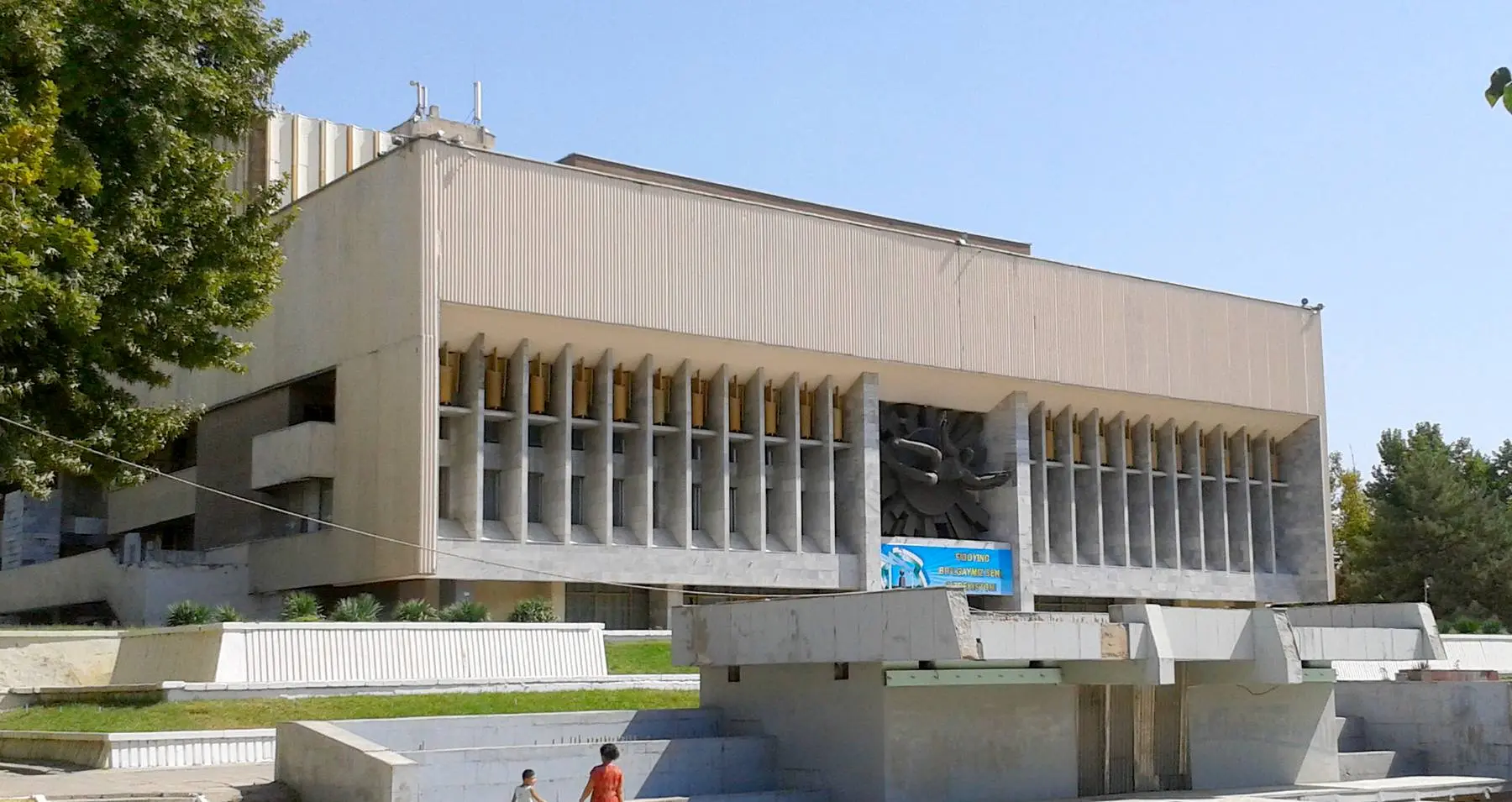
Palace of Culture of Aviation Builders
About the Object
F. Ashrafi (head of the authors' team), A. Onishchenko (chief project architect), R. Takhtaganov, M. Vakhidov, Yu. Korostelev; engineers R. Nasretdinov (chief project engineer), A. Talipov, V. Kaliberdin, A. Zaripov; mosaics by Izzet Ablaev ("Music") and Khadzhi-Murat Kalagov ("Art"); relief of Icarus by Robert Avakyan and Albert Ovsepyan
1980
Modernism
Улица Корасув, 1/1, угол улицы Авиасозлар, Ташкент (Яшнабадский район, жилой городок авиастроителей)
Public Building
Gallery (1)

The Palace That Refused to Be an Airplane
The Chkalov Tashkent Aviation Plant was evacuated here from Mytishchi near Moscow in the winter of 1941-1942 and over the next thirty years acquired its own infrastructure that a small town would envy: a residential microdistrict, a medical station and hospital, children's camps, recreation centers and boarding houses, a stadium, a cinema. The Palace of Culture became the final and largest link in this system. Later, funded by the plant, the Chkalovskaya metro station would also be built. It was built for the new Khamza district, formed in 1968 and designed for one hundred and fifty thousand residents, most of whom were connected to the plant in one way or another. The public center of the district was conceived in two phases: first the cultural part, meaning the palace itself, then the public center proper - a U-shaped block adjoining the palace at the back. The second phase was never built, which was common for the late USSR: the exact same thing happened with the Palace of Pioneers, which was being built in the same years. The palace took on some of the functions of the public center - for some time it even housed the registry office. It is a large building, raised on a high stylobate, with an esplanade-square with fountains in front of it. And this is where things get most interesting. By the late seventies, Soviet architects in Uzbekistan had an almost mandatory set of techniques: grilles, ornament, arches, a "national form". In the early version of the project, preserved in a photograph of a 1976 model, all of this was present: frequent vertical sun louvers at the top, large schematized ornament at the bottom, concrete grilles on the side facades. The project looked noticeably more banal than what was built. The rejection of ornamentality, according to architect Rafail Takhtaganov's recollections, was conscious and principled: back then, national motifs were everywhere, and the authors had no desire to "blast out something archy, trademark-like". The authors also abandoned the second obvious theme - aviation. The client was an aviation plant, and an airplane on the facade would have looked natural, but the building says nothing about airplanes. Instead of two ready-made themes, the architects began to work with scale, rhythm, proportions, and materials. Capped within a horizontal rectangular frame, the main facade features a wide upper and narrow side transoms made of corrugated concrete, with the lower part made of tufa. Inside the frame are marble sun louvers that create an alternation of protruding lightened and recessed shadowed wall areas, with cylinders made of bent brass sheets standing in the shadowed sections. Concrete is used here unlike the usual practice of the Brutalist wave: not mass and rough texture, but a neat, precise surface, as if combed with a fine-toothed comb. Stone is a separate story. Rafail Takhtaganov first saw the golden-tobacco tufa in Stroymaтериалы-72 (Construction Materials-72) magazine, published after the international exhibition in Moscow. He managed to convince the client that this exact color should be on the facades, flew to Armenia himself to buy the stone, and then several thousand square meters of selected tufa were flown to Uzbekistan by planes. Once on the building, builders polished it by hand to achieve the desired radiance. And only in one place did the authors permit themselves a plot. Above the central entrance is a bronze relief of Icarus by sculptors Robert Avakyan and Albert Hovsepyan. The choice is strange: Icarus fell into the sea and died, and for a palace of aircraft builders, this is, to put it mildly, an ambiguous emblem. But Icarus in Soviet monumental art of the sixties to eighties was an almost routine figure, along with Prometheus, he was responsible for daring, science, and flight. At the same time, the Tashkent Icarus is more human than heroic: he is naked, he is not striving upward, but has frozen as if at the last point of equilibrium, and the huge sun behind his back seems dangerously close to the wax-fastened wings. Inside, the core was a versatile hall with fifteen hundred seats, according to Takhtaganov's recollections, the largest in Tashkent at the time. A stage with an orchestra pit, a revolving stage and ring, a full set of film projection equipment and theatrical lighting allowed the hall to host anything in any genre. On the ground floor lobby, visitors were met by a semi-abstract mosaic titled "Music" by artist Izzet Ablaev, combining space and dance, while the second floor featured the mosaic "Art" with figures personifying various art forms, created by Khadzhi-Murat Kalagov. Chandeliers assembled from thousands of glass elements descended through round openings from the third floor to the second, and deep light wells were arranged in the third-floor ceiling - a technique familiar from Alvar Aalto's library in Vyborg. The palace was assembled from all over the Union, which was the norm for the late USSR: stone from Armenia, furniture from Romania, chandeliers from Khimki near Moscow, stained glass technology from Kyiv - the stained glass itself was made at the aviation plant, and the curtain was sewn in the workshops of the Bolshoi Theater. Curiously, despite the deliberate rejection of the aviation theme, an outside eye still imagines it: the German monument inventory of Tashkent describes the facade of the palace as "remotely resembling an airplane". Apparently, the authors never intended anything of the sort.
AI translation · 🇬🇧 EN
Rate this review:
April 22, 1980: The key, the ribbon, and the prize that wasn't given to everyone
The Palace was opened on April 22, 1980 - on Lenin's birthday, for his 110th anniversary. "Pravda Vostoka" described it the next day in an article titled "A Gift - A Workers' Palace." The workers of the V. P. Chkalov Aviation Production Association received a symbolic key shining with gold from the builders of the "Vysotstroy" trust. The newspaper then listed what was behind the door: a multipurpose hall with fifteen hundred seats, equipped for any entertainment events and meetings; a dance hall; spacious foyers; club and rehearsal rooms; a library with one hundred thousand volumes - "and much more." Speeches at the rally were given by V. Kaliberdin, manager of the "Vysotstroy" trust; N. Ilyasov, a roofer and representative of the association; and V. Sivets, general director of the association - the very person whose name the palace bears today. The ribbon at the entrance was cut by Sharaf Rashidov, First Secretary of the Central Committee of the Communist Party of Uzbekistan. On the same day, a rally of shock workers of communist labor - winners of the competition in honor of the Lenin jubilee - took place in the palace. Six months later, in November 1980, reporting on the results of the year, the plant listed its achievements as follows: preschool institutions were commissioned, "a unique Palace of Culture was put into operation," and the wages of aircraft builders increased by fourteen percent. The palace stands in this list between kindergartens and wages - and this quite accurately shows what it meant to the plant. And in 1984, a decree was issued on the awarding of the Hamza State Prizes of the Uzbek SSR for 1983, and it contains a line about this palace. This line is interesting for whom it names. Firuz Mukhtarovich Ashrafi is named as the head of the team of authors. Anatoly Ivanovich Onishchenko is the chief architect of the project. Rahim Akhmedovich Nasretdinov is the chief engineer of the project. Next are architect Mukhammat Khurmatovich Vakhidov, engineer Vasily Vasilyevich Koliberdin, civil engineer Abdulla Agzamovich Zaripov, and monumental artists and sculptors Khaji-Murat Khikanosovich Kalagov and Albert Karapetovich Ovsepyan. Two things in this list are worth noting. First: among the laureates was the manager of the trust that built the palace - the very same Kaliberdin who handed over the key at the opening. You don't often meet a builder in the same row as architects and artists. Second: the list does not include Rafail Takhtaganov - the very person who traveled to Armenia for tuff and insisted on abandoning ornament. The reason, according to his own account, was bureaucratic: two years earlier he had already received the Hamza prize for the statue of Avicenna in the village of Afshana, and becoming a laureate twice in such a short period was "not allowed." The subsequent life of the palace turned out more successfully than that of most buildings of this type. After 1991, the system of culture houses and palaces throughout the post-Soviet space was left without money and quickly fell into decay; by 2000, more than a third of such buildings were in an emergency state. The Tashkent Palace continued to operate, and at the turn of the nineties and two-thousands, it became a venue for KVN games, which added to its popularity among the new generation. In 2013, the Chkalov aviation association was finally closed, but the palace was transferred to the jurisdiction of the Ministry of Internal Affairs of Uzbekistan, and it retained both its function and interiors - a rare case of such complete preservation for the seventies. Risk came from another side. In the early 2020s, a reconstruction project was developed, according to which the palace is to acquire those very "national" features that its authors consciously rejected, and lose Icarus.
AI translation · 🇬🇧 EN
Rate this review:
Nearby and related
By the same architect
Close by in Tashkent
About the Object
F. Ashrafi (head of the authors' team), A. Onishchenko (chief project architect), R. Takhtaganov, M. Vakhidov, Yu. Korostelev; engineers R. Nasretdinov (chief project engineer), A. Talipov, V. Kaliberdin, A. Zaripov; mosaics by Izzet Ablaev ("Music") and Khadzhi-Murat Kalagov ("Art"); relief of Icarus by Robert Avakyan and Albert Ovsepyan
1980
Modernism
Улица Корасув, 1/1, угол улицы Авиасозлар, Ташкент (Яшнабадский район, жилой городок авиастроителей)
Public Building