
Donatello (Donato di Niccolò di Betto Bardi)
About the Object
Donatello
1386
Other
Via dell'Arte della Lana, Firenze
Historic Personality
Gallery (1)

He was the first since antiquity to place a nude figure-and started the block that became 'David'
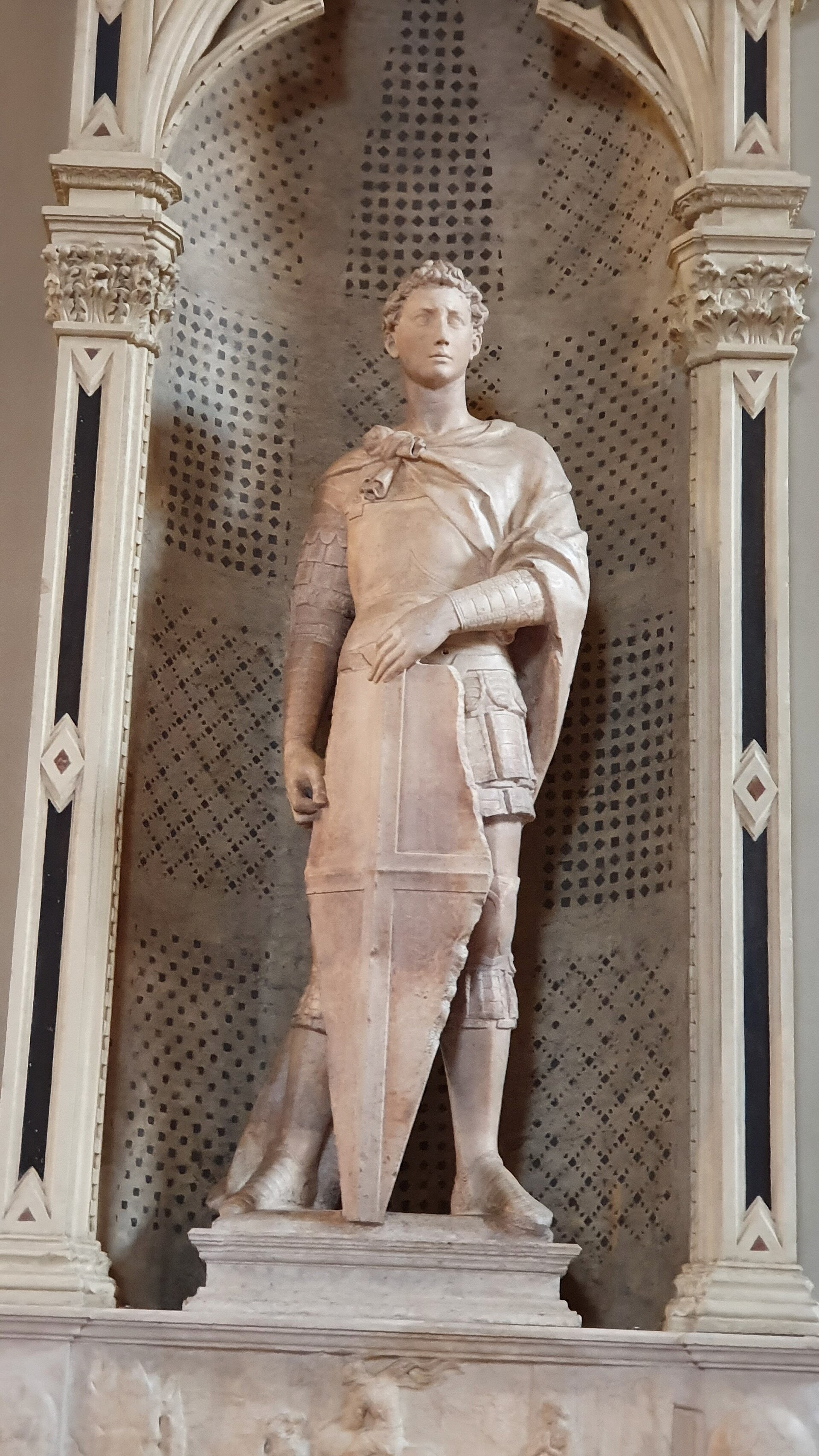
You are by Orsanmichele, at the building where the guilds displayed their patron saints in fourteen niches. Three of them are works by Donatello, and they are the best place to start a conversation about him. He was born in 1386 and learned his craft from childhood: at any rate, by the age of thirteen or fourteen he was already in Pistoia and, by all accounts, helping Brunelleschi there make the silver figures for the altar of St. James. His friendship with Brunelleschi lasted a lifetime: together they traveled to Rome to study antiquity, and in 1420 Donatello was appointed a consultant to the Opera del Duomo-the cathedral's building workshop-where he constantly saw Filippo and even worked with him. What he did to sculpture is easiest to understand through a single figure that once stood right here. Saint George was commissioned from him by the Guild of Armourers and Sword-makers around 1420, and the task was no simple one: to depict in marble a man entirely encased in the client's merchandise. The statue once wore a real metal helmet on its head, and held a real sword in its right hand, protruding outward into the street; both have long since been eaten away by rust. Donatello did not make a mighty warrior: his George is a lean youth, and the most important thing about him is his face. Not a fearless hero, but a sensitive, thinking young man with a slightly weak chin and a brow furrowed with tension. Judith Testa, whose guidebook to Florence is one of our primary references, reads it this way: courage, according to Donatello, is not about not being afraid, but about gathering yourself and stepping out to meet what you fear. Today the original is in the Bargello, and a copy stands in the niche. Next comes a list that biographies usually compress into a single line, yet it is worth dwelling on. Donatello was the first since antiquity to cast an equestrian statue and the first to place a free-standing nude figure-that very bronze 'David' now in the Bargello. Together with Michelozzo, he made the tomb of Baldassare Cossa, the antipope John XXIII, in the Baptistery: work began in the early 1420s, and this is the only tomb in the Baptistery-no one else is buried there. He is also responsible for the wooden Magdalene, the pulpits of San Lorenzo, and the reliefs that are now scattered among the city's museums. And one final story that connects him to a man born nine years after his death. From the early 1400s, the cathedral trustees conceived the idea of placing a chain of huge statues of Old Testament heroes on the buttresses. The project dragged on for decades. In the 1460s, Donatello, who was nearly eighty, received a commission for another such figure-this time in marble, larger than life-size. He could no longer pull such a massive block on his own, and work under his supervision was begun by the young sculptor Agostino di Duccio. In 1466 Donatello died, the trustees' interest in the enterprise faded, and the barely started block was left lying in the cathedral workshop. It lay there for thirty-five years-until in 1501 the twenty-six-year-old Michelangelo took it up. That is to say, the 'David' that the whole world knows as the statement of a single genius began as the unfinished work of another. Michelangelo knew this: he had studied Donatello's works, and among them were several 'Davids'. His task was not to "do his own thing," but to "finish what the elder started without falling short of him." Donatello was buried in San Lorenzo, in the Medici church, where the Medici themselves lie from Cosimo the Elder to Cosimo III. For a sculptor, this was a place above his station-and that is precisely why it is telling.
AI translation · 🇬🇧 EN
Rate this review:
Nearby and related
Close by in Florence
About the Object
Donatello
1386
Other
Via dell'Arte della Lana, Firenze
Historic Personality