
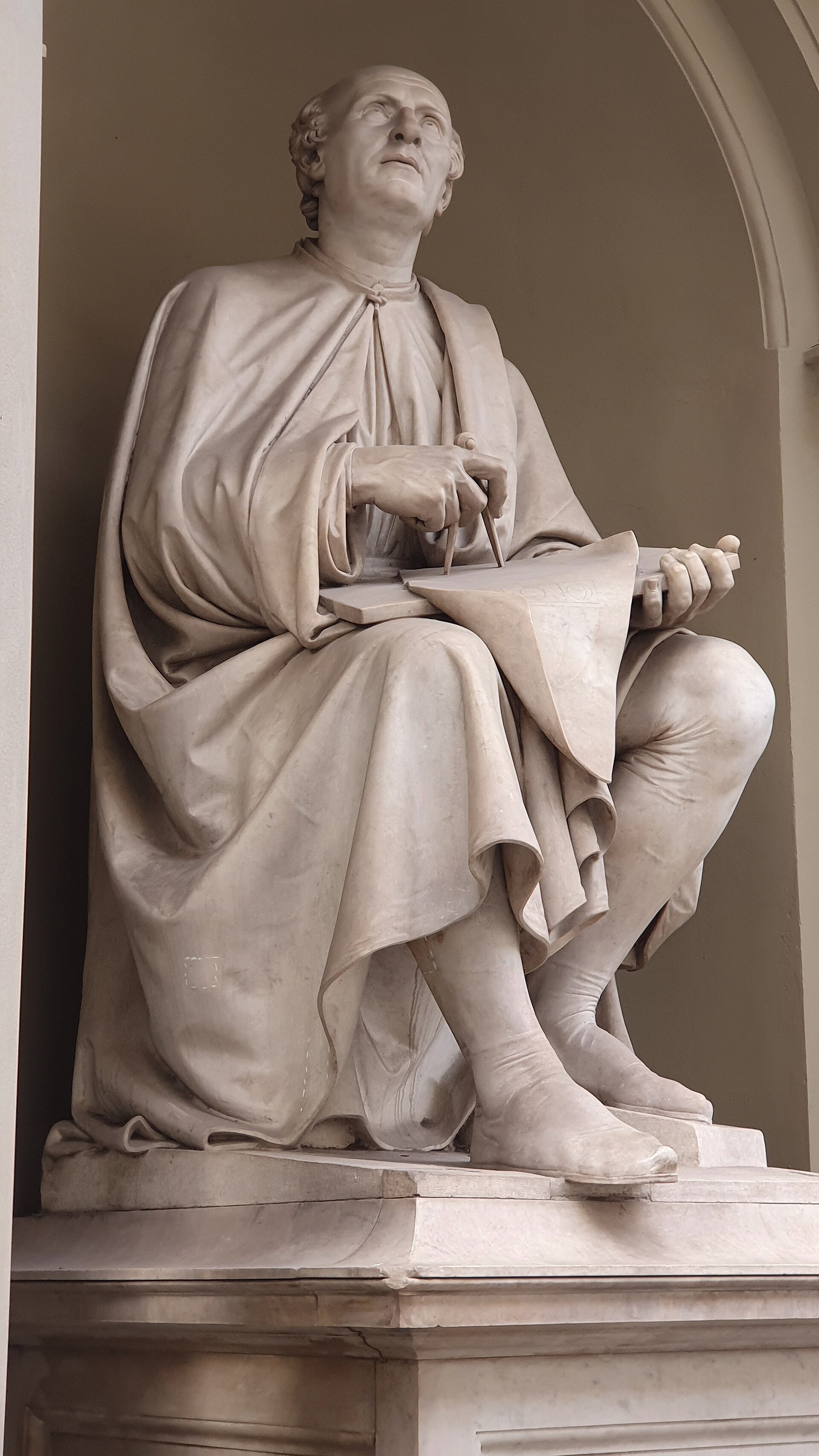
Filippo Brunelleschi
About the Object
Filippo Brunelleschi
1377
Other
Piazza del Duomo, Firenze
Historic Personality
Gallery (1)

The Goldsmith Who Lost the Competition and Was Buried in the Cathedral He Completed
You are standing by the cathedral, and above you is a dome known to the entire world. The man who built it did not come to architecture immediately, nor of his own free will. Filippo Brunelleschi was born in Florence in 1377 and trained as a goldsmith. This was no minor profession: goldsmithing was considered the most complex of the crafts, requiring knowledge of mathematics and mechanics, and therefore regularly led people into architecture. Others began the same way; he himself traveled to gain experience in Pistoia, in the workshop of the goldsmith Linardo di Matteo Ducci. In 1401, the city announced a competition for the new bronze doors of the Baptistery. Two locals reached the finals, Brunelleschi and Lorenzo Ghiberti, and Ghiberti won. What happened next is known for certain: Brunelleschi abandoned sculpture and left for Rome to measure and sketch ancient vaults. Two decades later, the city would search for a man who could finally cap the hole over the crossing of the cathedral with a dome-and such a man turned out to be the only one. He never knew how to lose. When, more than forty years later, Cosimo de' Medici asked him to design a family palazzo and then deemed it too lavish and passed the commission to Michelozzo, the story goes that Brunelleschi smashed his wooden model at the client's feet and left. This story is worth holding onto for what it is: a narrative, rather than a protocol. But it well explains the main circumstance of his later years: he never became the architect of the Medici. After 1434, when Cosimo returned from exile and the city effectively passed to him, commissions went one after another to other masters, and the cathedral construction remained almost the only large site where work proceeded as before. Brunelleschi worked for the commune-and remained the master of the commune. The dome was finished in 1436, and they celebrated twice. On March 25, Pope Eugene IV solemnly consecrated the cathedral, but this was more of a political move: it was important for Florence to show itself to Europe. The completion was truly celebrated on August 30, when the ceremony of the final stone was held and the Bishop of Fiesole climbed the spiral staircase to the very top to consecrate the dome and bless the church from above. He did not marry, and he had no children; his adopted son Andrea Buggiano became his heir. In March 1446, the archbishop consecrated the first stone of the lantern-that turret crowning the dome-and less than a month later Brunelleschi died, having lived just shy of seventy. He was buried inside the cathedral: a rare honor, the city did not do this for just anyone. The epitaph was composed by the chancellor of the republic, Carlo Marsupini, and it compares Filippo to Daedalus: "How valiant architect Filippo was in the art of Daedalus is attested both by the wondrous dome of his most famous temple and by many devices invented by his divine genius." Pay attention to what stands next to the dome in this phrase. Devices. That is what the second story is about.
AI translation · 🇬🇧 EN
Rate this review:
Machines, a Patent, and a Spiteful Epigram: Brunelleschi Through the Eyes of His Contemporaries
To us, he is known as an architect. His contemporaries saw him primarily as an engineer and inventor, and this is no exaggeration by descendants: it is written on his tomb, where, next to the dome, are named the "devices invented by his divine genius." The reason is simple. The dome had to be raised to a height where materials still had to be delivered, and Brunelleschi made machines for this purpose. Hoisting gear was literally part of his profession: models of lifting devices were a mandatory item in the competition briefs of the time-meaning the architect was expected to provide not only the form, but also the method to lift the stone. Some of these mechanisms can still be seen today, exhibited in the Museo dell'Opera del Duomo a stone's throw from here, looking like instruments of unknown purpose. Then begins a story that is rarely told. In 1421, Brunelleschi obtained a patent for a vessel of his own design-a barge intended to transport building stone from Pisa to Florence up the Arno. The barge was built. It never reached Florence: it only made it as far as Empoli and Castelfranco. Florence was a sharp-tongued city, and his failure was brought up immediately. Giovanni Gherardo da Prato-not an insignificant man, he lectured on Dante at the University of Florence-wrote a sonnet about Brunelleschi that instantly circulated around the city: "O bottomless pit, muddied by ignorance, O lowest of beasts, devoid of reason, you wish to pass off a feeble firefly as a bright lantern, but all your alchemy, alas, is powerless... But if your barge, incapable of floating, is nevertheless built, which I do not believe, I will not only interrupt my lectures on Dante, but will end my own life with my own hands." The accusation here is not about the barge. Giovanni says that Brunelleschi passes off the impossible as possible and wins over the public with a miracle-that is, he accuses him of charlatanry. One can understand him: to an educated contemporary, a man who promised to vault the largest span in the Christian world without centering looked precisely like that. And another story, vouched for by his biographer. Antonio Manetti, writing about Brunelleschi at the end of the century, recounts that in 1426, when it came time to install the wooden tension-chain binding the dome, Filippo took to his bed. Work stopped: it was to be led by the second construction manager, Ghiberti, and he did not know how. The moment Ghiberti finally began-Brunelleschi miraculously recovered, appeared at the site, climbed to the top, inspected what had been done, and declared it worthless. The chain was ordered to be dismantled and redone under his personal supervision. The cathedral trustees tripled Brunelleschi's salary and suspended Ghiberti; he was later reinstated, but with reduced authority and pay. This is Manetti's account, not a document. But it explains why everything related to the dome is shrouded in such secrecy, and why the method by which Brunelleschi calculated the increasing inclination of the masonry courses still remains among the unsolved mysteries.
AI translation · 🇬🇧 EN
Rate this review:
Nearby and related
Close by in Florence
About the Object
Filippo Brunelleschi
1377
Other
Piazza del Duomo, Firenze
Historic Personality