
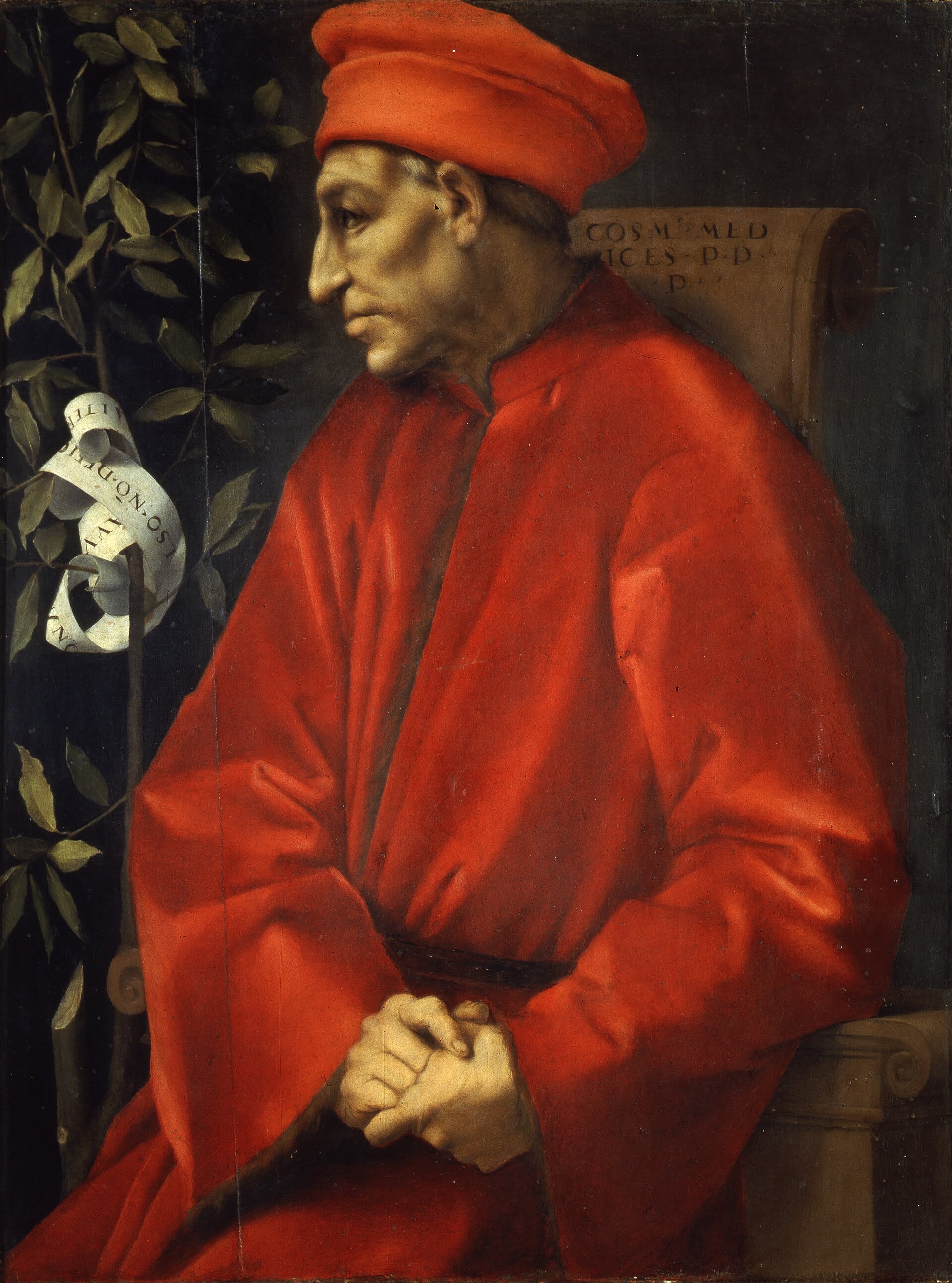
Cosimo de' Medici the Elder
About the Object
Cosimo de' Medici the Elder
1389
Other
Piazza San Lorenzo, Firenze
Historic Personality
Gallery (1)

The Man with the Scepter under His Cloak
You are standing by San Lorenzo, the Medici parish church. Beneath its floor lies a man who ruled Florence for thirty years without ever holding public office. Cosimo di Giovanni de' Medici was born in 1389, inheriting a bank and a love for banking from his father. He used to say that he enjoyed the business so much he would stay in it even if it weren't profitable. It was profitable-and it made him the richest man in the city. Next comes the structure of power, which is worth understanding because the entire Florentine history of the following century rests upon it. Cosimo did not meddle in politics directly: he maintained his father's habit of modesty and caution, rarely thrusting his hand into the boiling cauldron of Florentine factions. Instead, he had a network-relatives, friends, business partners, debtors, and clients who owed him everything. Cosimo's rival, Rinaldo degli Albizzi, wrote a phrase about him in 1433 that no one has ever captured more accurately: "He lacks only the scepter of rule; or rather, he has the scepter, but he hides it beneath his cloak." In that same year of 1433, the Albizzi staged a coup. Cosimo was arrested and imprisoned in a tiny cell at the top of the Palazzo Vecchio tower-a cell the Florentines, with their dark humor, called the "alberghetto," or little hotel. For four days he refused to eat, fearing poison, yet he kept his composure and befriended his jailer, who agreed to let him go. He left for Venice-and this is where the real story begins. In Venice, Cosimo behaved not like a fugitive, but like a man who had left voluntarily, letting it be known that he was considering moving his bank's headquarters there. That is, depriving Florence of its main financial institution and driving the city to the brink of ruin. His enemies expected the bank to collapse without its master; instead, the bank, managed by his relatives and close friends, flourished. The Florentines were quite quickly made to understand just how much they needed him. A year later, in 1434, Cosimo was brought back. With this return begins the rule of the Medici, which would endure, with interruptions, for three centuries. He died in 1464 at the age of seventy-five. He refused to draw up a will, saying it was unnecessary: he trusted the abilities and love of his children. Shortly after his death, the city bestowed upon him a title it had given to no one else: Pater Patriae, Father of the Fatherland. These words are carved upon a simple tombstone in the floor of San Lorenzo-you can see it when you step inside the church.
AI translation · 🇬🇧 EN
Rate this review:
What he spent on: a monastery, a palace, books, and Greeks from fallen Constantinople
One might easily think that Cosimo was buying the city. To put it differently: he was buying things that outlived both him and his bank. He built a lot and all at once. In 1437, the reconstruction of the San Marco monastery began, where Dominicans from Fiesole moved at his invitation; he provided the funds, and Michelozzo was the architect. In San Marco, Cosimo set up a cell for himself next to the library - not just for prayer, but to study sciences and contemplate there. The richest man in Florence kept a room for himself in a monastery: this is not a pose, this is how his day was structured. Then came his own palace on Via Larga, now the Medici-Riccardi. The commission, as the story goes, was first discussed with Brunelleschi, but his design was deemed too luxurious, and Michelozzo built the palace instead. Cosimo remained true to himself here as well: the exterior of the building is deliberately austere. Florence did not like it when wealth was flaunted. And then there is what cannot be seen at all. Cosimo supported scholars and philosophers - both Italians like Marsilio Ficino and numerous Greeks who fled Constantinople after its fall in 1453. He paid them a salary and opened his personal library and the library of San Marco to them. From this stemmed everything else: the study of antiquity in general and Plato in particular, and knowing Greek became something of a fashion among educated Florentines. It is worth pausing here and saying aloud what is usually rushed through. The Renaissance is not only about buildings and paintings. It is also about the decision of a specific wealthy man to pay salaries to refugees who brought with them books in an incomprehensible language. Did this end well for the city? There are different opinions on this matter, and our guide to Florence, Judith Testa's book, evaluates Cosimo's descendants much more harshly than him himself. But the very habit of Florentine rich men of investing in buildings and manuscripts received a theoretical justification in those same years: Leon Battista Alberti linked the old virtue of magnificence specifically with the commission of buildings - he who built a beautiful building adorned not only his own life, but public life as well. Cosimo built precisely within this framework, and sometimes, it seems, even before it was formulated.
AI translation · 🇬🇧 EN
Rate this review:
Nearby and related
Close by in Florence
About the Object
Cosimo de' Medici the Elder
1389
Other
Piazza San Lorenzo, Firenze
Historic Personality