
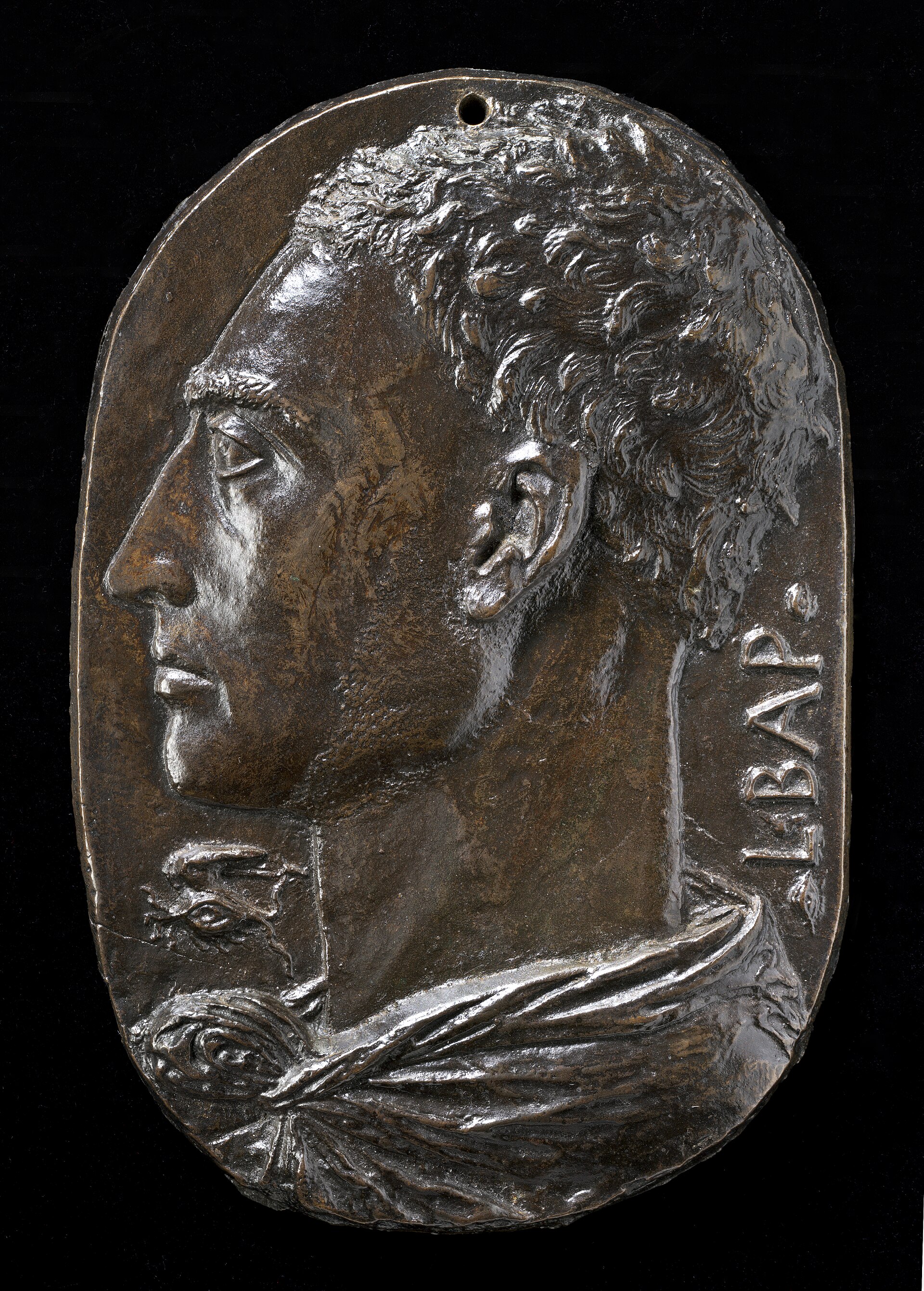
Leon Battista Alberti
About the Object
Leon Battista Alberti
1404
Other
Piazza di Santa Maria Novella, Firenze
Historic Personality
Gallery (1)

The first architect who wrote a book instead of building
Before you is the facade of Santa Maria Novella, and two blocks away stands the Rucellai Palace. Both were made from the drawings of one man, and he likely did not spend a single day on either of these construction sites in the role of a master builder. This is precisely his novelty. Leon Battista Alberti lived from 1404 to 1472 and was not a craftsman, but a scholar - someone of the kind then called a humanist. He wrote about painting, the family, and morals, and served at the papal curia. Architecture was an object of reflection for him before it became an occupation. In 1435, he dedicated his book on painting to Brunelleschi, and the dedication is worth reading in full because it is the best thing contemporaries said about the dome: "Who would be so hard-hearted or so envious as not to praise Filippo the architect upon seeing such a huge structure, lifted above the skies and wide enough to cast its shadow over the entire Tuscan people?" Notice the speaker's position: this is written not by a trade rival, but by an outsider who knows how to articulate things. His main work is called "Ten Books on Architecture" - De re aedificatoria. He wrote it by 1452, it was printed in 1485 after his death, and it is the first great architectural treatise of the Renaissance. Jonathan Glancey explains what it changed fundamentally: with the appearance of the book, the design began to travel independently of the author, and the architect ceased to be tied to the construction site. Before this, a building existed where the master stood. After - where the book was read. Florence gave Alberti precisely two clients, or rather one: Giovanni Rucellai, a wealthy wool merchant who commissioned both the facade of his own palace and the facade of Santa Maria Novella. Look at the palace - it is made almost like a study chart of the orders: Doric pilasters at the bottom, Ionic higher up, Corinthian on the top floor, in order of increasing complexity. No one in Florence had applied the antique system to a residential building in this way before him. And one more thing that Alberti gave his time, even though it is not made of stone. It was he who connected the old concept of "magnificence" - the virtue of a generous person - with the erection of buildings: he who erected a beautiful building adorned not only his own life, but public life as well, and brought honor to himself, his family, his descendants, and the city. The wealthy Florentines who began racing to build palaces from the middle of the century operated within this framework. That is to say, Alberti wrote not only the rules of architecture, but also a justification for those who commission it. Finally, the place where you can look at him. In the Brancacci Chapel, in the Church of Santa Maria del Carmine across the river, in Masaccio's fresco "The Tribute Money," a group of men in dark clothing stands on the right. The two in the front row are usually identified as Alberti and Brunelleschi. This is not a document, but a tradition of identification, yet a long-standing one.
AI translation · 🇬🇧 EN
Rate this review:
Nearby and related
Close by in Florence
About the Object
Leon Battista Alberti
1404
Other
Piazza di Santa Maria Novella, Firenze
Historic Personality